
Active Warrants in Essex County
Warrants in Essex County are issued by District Court and Superior Court judges and clerk-magistrates. They do not flow into a single public list. A warrant enters the Massachusetts court record when a judge signs it, and the status appears on the case docket in MassCourts. That means the best free tool for an Essex County warrant search is the same tool used for any other court record: MassCourts eAccess.
When a warrant or default is issued on a case, a docket entry records it with a date and reason. If the warrant is later recalled or the default removed, another entry reflects that. The docket is not always up to the minute. A new warrant may take time to appear. A recalled warrant may take time to clear across systems. Always confirm status with the court clerk before acting on what you read online.
The Essex County Sheriff's Department handles warrant service and custody after arrest. The Essex Sheriff does not publish a public active-warrant list. For active arrest-risk questions, consult counsel before approaching any courthouse or police agency.
Types of Essex County Warrants
Massachusetts courts issue several types of warrants. The type matters because it affects who executes it, how bail is handled, and what steps are needed to clear it. Not every warrant is a criminal matter.
- Arrest warrant
- Authorizes law enforcement to take a named person into custody based on a criminal complaint, indictment, or failure to appear. A judge or clerk-magistrate issues it after finding probable cause.
- Bench warrant / default warrant
- Issued when a person misses a required court date. Courts also call this a "default." It may apply in criminal, civil, or motor-vehicle matters. The person must appear to have it recalled.
- Search warrant
- Authorizes police to search a specific place, person, or property. It does not target the suspect for arrest by itself. Search warrants are often sealed during an active investigation and may never appear on a public docket.
- Probation warrant
- Issued when a person allegedly violates probation conditions. The Probation Department triggers it, and a judge signs it. The person must appear before the supervising court.
- Civil capias
- A court-ordered pickup that can arise in contempt or supplementary process matters under Massachusetts civil procedure. Less common than arrest or bench warrants, but it does appear in docket records.
Note: Juvenile warrants are subject to the same confidentiality limits as other juvenile records and generally do not appear in public docket searches.
How to Find Essex County Warrant Information
Because no public warrant portal exists for Essex County, finding warrant or default information means working through the case docket. If you know the case number or the person's name and the court that filed the case, you can usually find the docket entry. The process below works for both arrest warrants and bench warrant defaults.
- Open MassCourts eAccess at masscourts.org and choose the correct search path, such as criminal or civil.
- Select the court department and location. Essex District Court sits in Salem, Lawrence, Lynn, Haverhill, Peabody, Gloucester, Ipswich, and Newburyport. Superior Court is in Salem.
- Enter the case number if you have it. A case number gives the cleanest result and avoids name-match problems.
- Search by name if you have no case number. Use last name, narrow by first name, and filter by court department and approximate filing year.
- Open the case detail and read the docket entries. Look for entries labeled "warrant issued," "default entered," "default removed," or "warrant recalled."
- Contact the clerk directly if the docket does not show a clear status. Call or visit the clerk's office at the Essex court location that holds the case.
- Avoid third-party warrant sites. Sites that claim to show active warrants for a fee or with a sign-up are not official sources. They may be outdated, inaccurate, or misleading.
Local police departments also maintain warrants on their systems. If the matter involves a municipal warrant issued through a local court, contact that city's police department or the relevant clerk-magistrate's office directly.
What an Essex County Warrant Record Shows
When a warrant or default appears in the MassCourts public docket, it shows up as part of the case record rather than as a standalone warrant document. The fields below describe what you can typically read from the docket entry. Some fields may not be visible on every case, depending on case type, impoundment, or court-entry timing.
| Field | What It Shows |
|---|---|
| Case Number | The docket number assigned by the court that issued the warrant. Format varies by department and year. |
| Defendant / Respondent Name | The person named in the warrant. Sensitive cases may have restricted name display. |
| Court Department / Location | The Essex District or Superior Court session, such as Salem, Lawrence, or Lynn, that issued the warrant. |
| Charge / Case Type | The criminal complaint, offense description, or civil matter tied to the case. |
| Warrant / Default Date | The date the warrant was issued or the default was entered on the docket. |
| Reason | The triggering event: failure to appear, probation violation, new complaint, or contempt. |
| Bail / Bond Condition | Any bail amount or release condition set by the court, where public on the docket. |
| Status | Whether the warrant is outstanding, recalled, executed, cancelled, or the default removed. |
| Next Court Date | A hearing date entered after arrest or recall, if the court has scheduled one. |
The docket shows events, not the underlying warrant document itself. To get a copy of the signed warrant, contact the clerk at the issuing court. Some documents may be restricted or available only to parties and counsel.
How to Resolve an Essex County Warrant or Default
An outstanding warrant or default does not clear on its own. The court must take a formal action to recall it, and the person must usually appear. Acting quickly and correctly can affect bail, whether arrest occurs, and how the underlying charge is handled. The steps below apply to bench warrants and defaults; an arrest warrant on a new charge may require a different approach.
Important: Consult a licensed attorney or contact CPCS before appearing at court or a police agency on a criminal warrant. Knowing your bail risk in advance can protect your rights and your safety.
- Check the docket first. Search MassCourts for the case. Confirm whether the warrant or default is still active or has already been recalled by a prior order.
- Contact the clerk's office at the District or Superior Court that issued the warrant. Ask about the procedure to remove the default, the current bail status, and whether a new hearing date can be set.
- Seek legal counsel. If charges are criminal and you cannot afford a lawyer, contact the Committee for Public Counsel Services (CPCS) to ask about appointed counsel. You can also visit MassLegalHelp for free self-help guidance.
- Gather your documents. Bring a government-issued photo ID and your case number. If the default is for nonpayment or noncompliance, bring proof of payment or completion where relevant.
- Appear at the designated court session. Be prepared for the possibility of custody if bail has not been arranged in advance. Your attorney or a bail commissioner can help address bail before you walk in.
- Confirm the docket update. After the court recalls the warrant or removes the default, check MassCourts again. Clearance may not appear immediately and may lag in law-enforcement databases.
For probation warrants, the process usually runs through the Probation Department at the issuing court rather than the clerk's office. Contact probation or your attorney for the correct steps. Failing to address a warrant only adds risk; courts can hold it against bail requests and sentencing if the underlying case goes forward.
Sealed and Restricted Essex County Warrant Records
Not every warrant is visible in a public docket search. Several categories of warrants are sealed or restricted by law or court order.
The image below is from the official Massachusetts Legislature page for M.G.L. c. 209A, the abuse-prevention statute. Violations of Chapter 209A orders can trigger warrants in a civil or criminal context. Records tied to those cases often carry address-confidentiality protections and may be impounded by order.
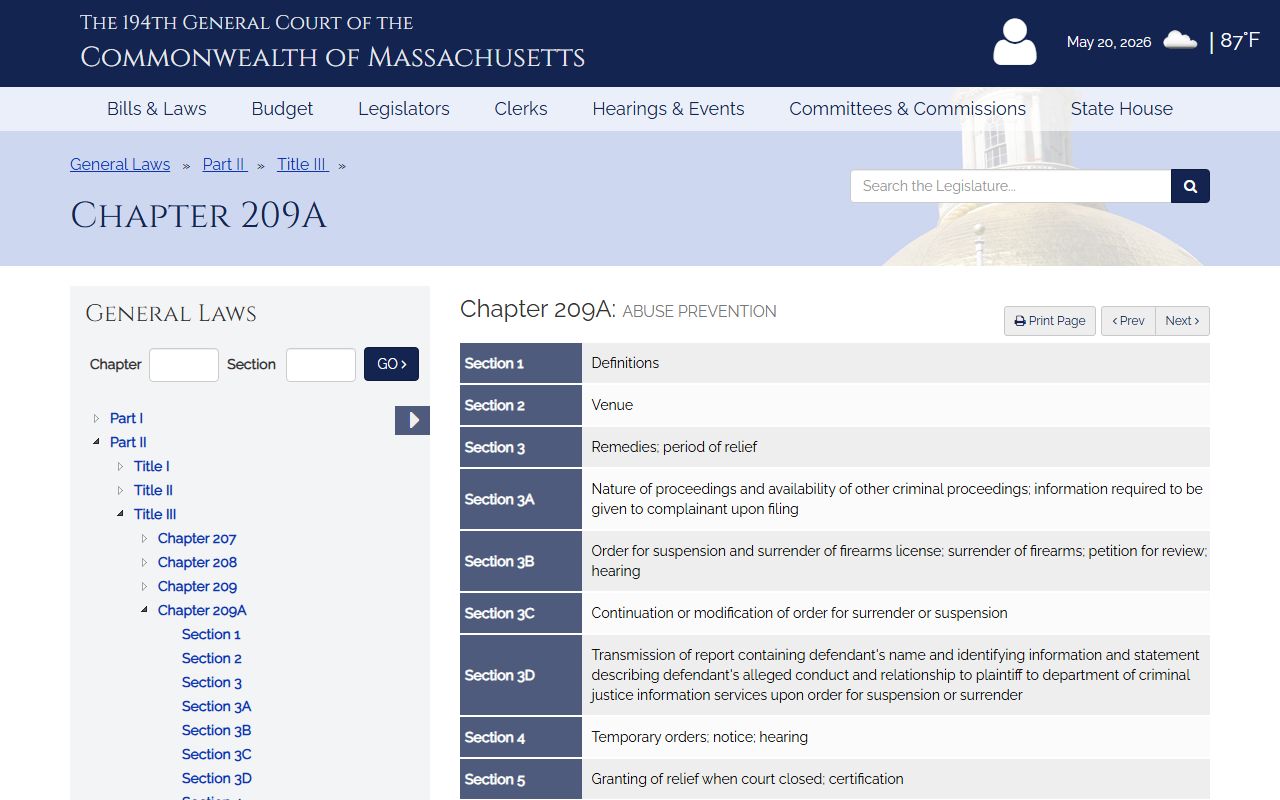
Warrants connected to abuse-prevention cases may not appear in a standard public docket search because the related case file or portions of it may be impounded.
Other categories that limit public warrant access include the following.
- Search warrants are frequently sealed during active investigations. They may stay sealed until the case is resolved, or they may never appear in a public docket at all.
- Juvenile warrants fall under the same confidentiality rules as juvenile case records under M.G.L. c. 119, § 60A. The public does not have routine access.
- Grand jury materials stay secret until an indictment is returned and made public at arraignment.
- Impounded case records may include arrest-warrant affidavits that a judge has ordered restricted under Trial Court Rule XIV.
If you believe a warrant exists but cannot find it in MassCourts, the record may be restricted, the case may have been filed in a court or department you have not searched, or the entry may not yet be updated on the public portal. Contact the relevant clerk's office for confirmation.
Sealed and Expunged Criminal Records in Essex County
A past warrant does not follow a person forever in every case. Massachusetts law allows eligible records, including those tied to dismissed charges or certain convictions, to be sealed or expunged through a formal process. Sealing restricts public access but leaves the record available to courts, law enforcement, and probation. Expungement goes further and results in statutory removal for qualifying matters.
The image below comes from the official statute page for M.G.L. c. 276, § 100E, which controls the expungement process in Massachusetts. Eligibility is narrower than sealing and depends on the offense, the outcome, and the person's history.
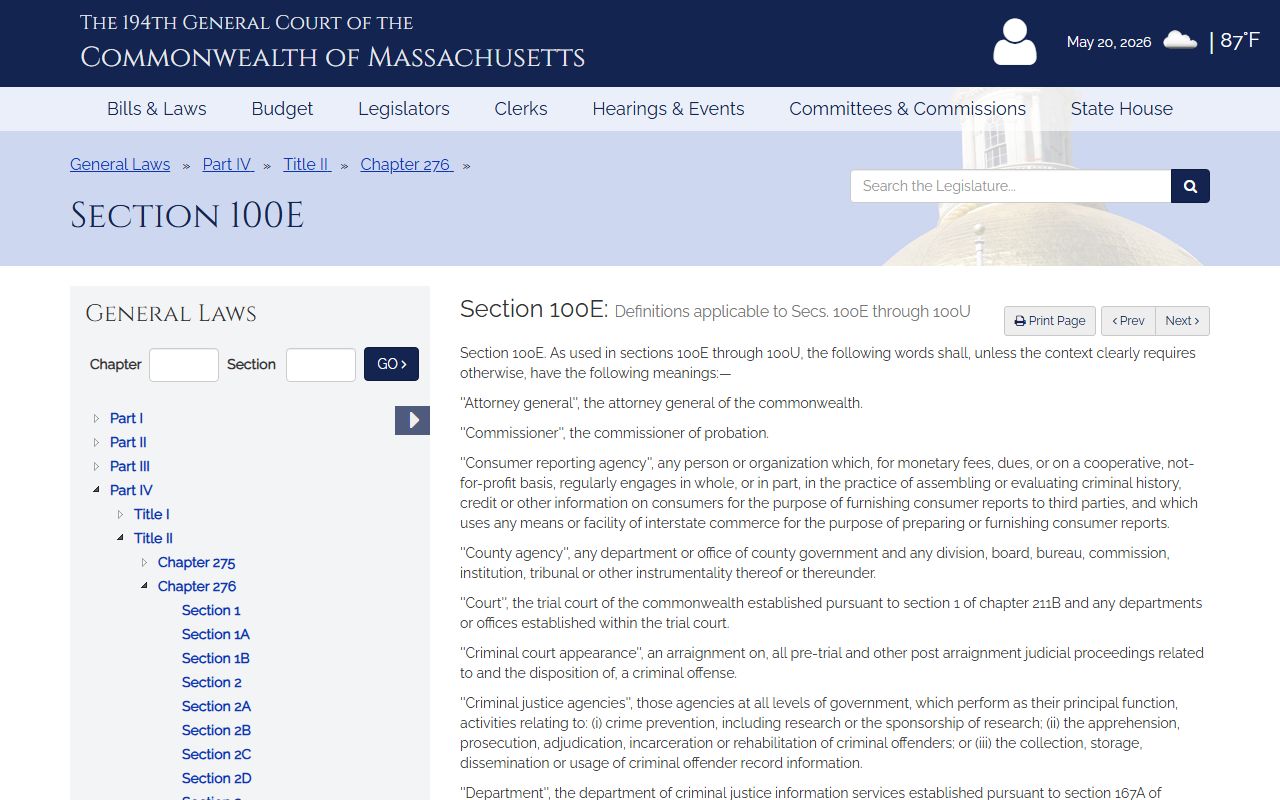
A record tied to a recalled warrant or a dismissed case may still be visible in public searches until a sealing or expungement petition is granted. The petition must be filed in the court that handled the original case.
Sealing under M.G.L. c. 276, § 100A and related provisions applies when eligibility requirements are met, including waiting periods and offense type. CPCS and MassLegalHelp both offer guidance on the petition process for people who need help understanding their options.
Essex DA, Public Defenders, and Legal Help
Warrant matters in criminal cases involve both prosecution and defense. The Essex District Attorney, currently Paul F. Tucker, prosecutes state criminal cases in Essex County and works with police and probation on warrant-related matters. Victims and witnesses can use the DA's official contact page for victim-witness assistance information.
On the defense side, people facing criminal warrants who cannot afford a lawyer should contact the Committee for Public Counsel Services. CPCS provides or appoints counsel for eligible indigent defendants in qualifying criminal and juvenile cases. Eligibility is based on financial screening at arraignment. For general legal self-help, MassLegalHelp covers warrant, bail, and default topics in plain language.
If you have already been arrested on an Essex warrant and are in custody, see the Essex County inmate records page for custody-status tools, including VINE and the Essex Sheriff contact information.