
What Essex County Probate Records Cover
Probate in Massachusetts goes beyond estates. The court also handles living-person matters such as guardianship and conservatorship. An estate file opens when someone dies and their property or debts need formal court administration. A guardianship case opens when a person needs someone else to make personal or medical decisions on their behalf. A conservatorship case addresses the financial side of that same kind of protection. Name changes and some trust matters also land in probate court.
Not every death triggers a probate case. Small estates, jointly held assets, payable-on-death accounts, and trusts can bypass formal probate. When probate is needed, the two main paths are informal and formal. Informal probate moves quickly when there is no dispute and the will, if any, is straightforward. Formal probate involves a judge and hearings, which is required for contested wills, missing heirs, complex assets, or cases that raise legal questions a clerk cannot resolve. A contested estate may stretch well beyond the typical timeline as parties file motions, conduct discovery, and litigate disputes over the will, creditor claims, or how the personal representative has managed assets.
Essex Probate and Family Court is the county venue for all of these matters. The court holds sessions in Salem and in Lawrence, which serves the northern and western parts of the county.
Essex Probate and Family Court Locations
The court runs two active locations for Essex County. Both handle the same range of probate and family matters, though cases are typically assigned to the location that serves the area where the petitioner or decedent lives. If you are not sure which location holds a file, the MassCourts portal can tell you by case number or party name.
The screenshot below is from the official Essex Probate and Family Court location page on Mass.gov, showing session and contact details for the Salem courthouse.
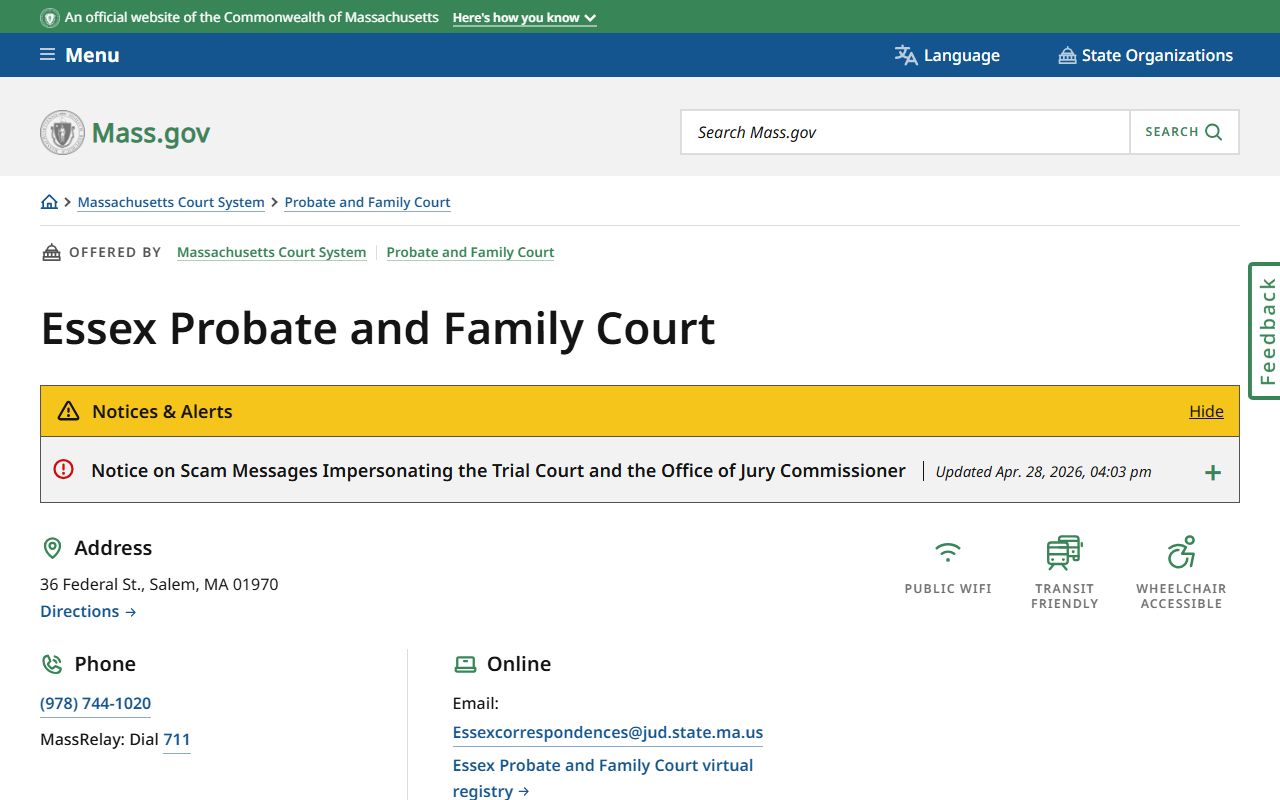
That page is the best starting point when you need hours, directions, or to confirm which division handles a specific probate matter in Essex County.
Essex Probate and Family Court (Salem)
Essex Probate and Family Court (Lawrence)
Note: Street addresses, phone numbers, and hours for both locations are listed on the official Mass.gov pages above and may be updated by the Trial Court at any time.
Probate Terms You Will See in Essex County Files
Probate documents use legal vocabulary that can be hard to read without context. The terms below appear in Essex County probate filings, case dockets, and court orders. Understanding them helps you read what a record actually means rather than guessing from context.
- Decedent
- The person who died. An estate file opens in their name.
- Testator
- A person who made a will. If the decedent left a valid will, that document controls who gets property and who serves as personal representative.
- Executor / Personal Representative
- The person appointed to administer the estate. Massachusetts uses the term "personal representative" under the Uniform Probate Code. This person inventories assets, pays debts, and distributes what remains to heirs or devisees.
- Intestate
- Dying without a valid will. An intestate estate follows the statutory order of inheritance set out in Massachusetts law, not the wishes of the decedent.
- Heir
- A person entitled to inherit under intestacy law when there is no will. Different from a devisee, who is named in a will.
- Devisee
- A person named in a will to receive property. The will controls what a devisee gets, not the intestacy statute.
- Guardianship
- A court proceeding that appoints someone to make personal and medical decisions for a minor or an incapacitated adult. The person subject to guardianship is called the ward or protected person.
- Conservatorship
- A court proceeding that appoints someone to manage the financial affairs and property of a person who cannot do so. A conservator handles money and assets; a guardian handles personal decisions. One person can hold both roles.
- Fiduciary
- A broad term for the person with a legal duty to act for another, such as a personal representative, guardian, or conservator. Fiduciaries can face court review of their accounts and actions.
How to Search Essex County Probate Records
Essex County probate cases are part of the Massachusetts Trial Court system, and most public dockets are accessible through MassCourts eAccess. The portal does not show every file. Restricted materials, sealed portions, and cases involving protected persons may not appear or may appear with limited detail. For older cases not yet in the digital system, contact the Register's office directly.
- Go to MassCourts eAccess and select the probate and family search path.
- Choose the court department as Probate and Family Court, then pick the Essex location, Salem or Lawrence.
- Enter the case number if you have it. A case number gives an exact result and avoids name-matching problems.
- If you do not have a case number, search by the decedent's or petitioner's last name and narrow with first name and filing year if known.
- Open the case record to see docket entries, parties, petition type, and case status.
- For documents not shown online, or for certified copies, contact the Essex Probate and Family Court Register's office at the Salem or Lawrence location that holds the file.
The table below shows the search fields available on the MassCourts portal when looking up Essex County probate records.
| Field Label | Type | Required | Notes |
|---|---|---|---|
| Court Department | Dropdown | Yes | Select Probate and Family Court. |
| Court Location | Dropdown | Yes / conditional | Essex Probate and Family Court or Lawrence session. |
| Case Number | Text | Optional | Best for an exact probate file lookup. |
| Decedent / Party Last Name | Text | Optional / conditional | Covers estate, guardian, conservator, petitioner, respondent. |
| First Name | Text | Optional | Narrows name-based results. |
| Case Type | Dropdown | Optional | Estate, guardianship, conservatorship, trust, name change. |
| Filing Date Range | Date | Optional | Useful for narrowing older probate results. |
| Search / Clear | Buttons | n/a | Search, Clear/Reset, View Details. |
What Essex County Probate Files Contain
A typical Essex County probate file holds more than just a will. The contents depend on the case type and how contested it became. Estate files tend to be the most document-heavy, especially when real estate, business interests, or disputes are involved. Guardianship and conservatorship files have similar structure but center on a living protected person rather than a decedent.
The following items commonly appear in an Essex County probate file. Not every item is in every file, and restricted materials may not be visible through the public portal.
- Case number, petition type, and status.
- Decedent, protected person, or minor name, and their petitioner and attorney.
- Personal representative, guardian, or conservator appointment.
- Date of death for estate cases.
- Will and any codicils, if applicable.
- Bond filed by the fiduciary.
- Citation and notice to heirs, devisees, and interested persons.
- Inventory of assets.
- Accounts and closing statements filed by the fiduciary.
- Decree or order from the court.
- Objections and appearances filed by interested parties.
Medical certificates and clinical-team reports appear in guardianship and conservatorship matters but are restricted from public access. Minor identities and protected-person details face the same limits.
The Essex County Estate Probate Process
Probate in Essex County follows the Massachusetts Uniform Probate Code, found at M.G.L. c. 190B. The screenshot below is from the official Massachusetts Legislature page for that chapter, which is the primary statute governing estate administration, guardianship, and conservatorship in the state.
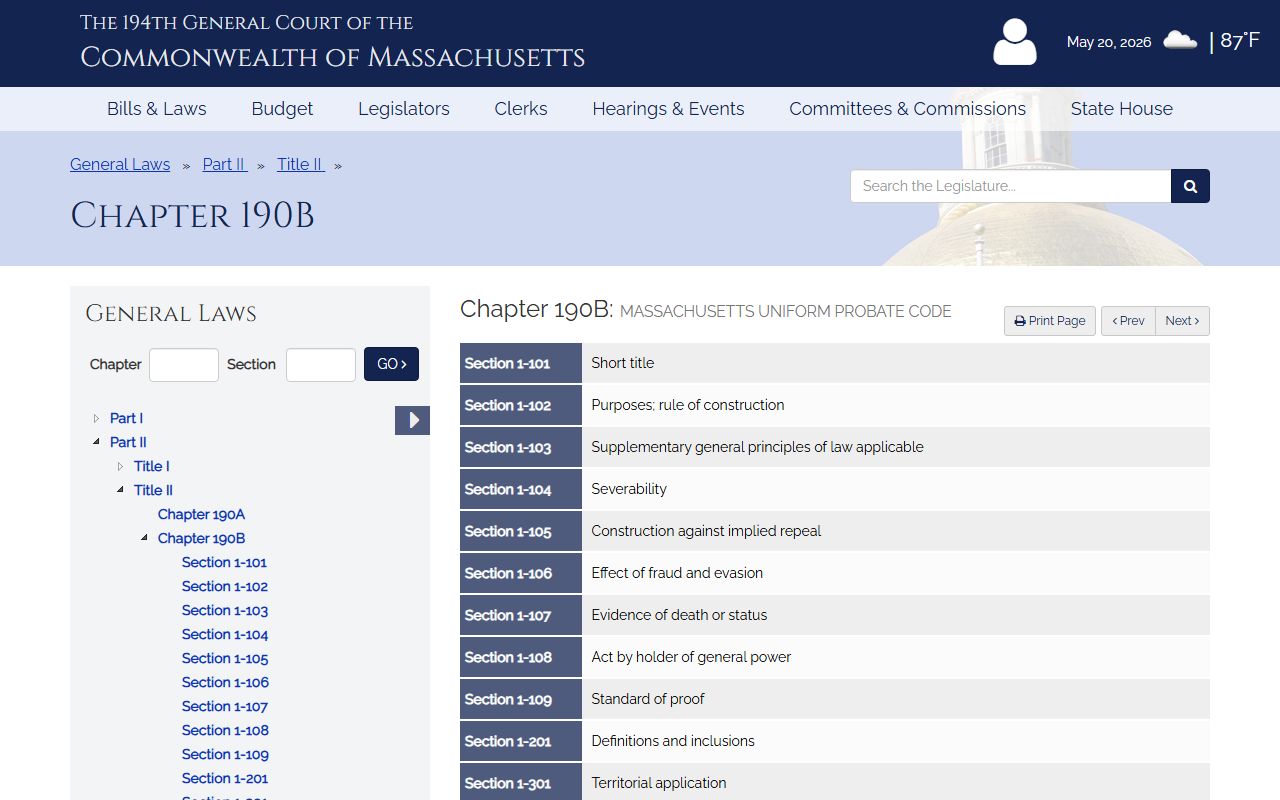
Chapter 190B sets out the procedures that Essex Probate and Family Court follows for every estate, guardianship, and conservatorship case in the county.
The steps below reflect the typical path through an Essex County estate case, from filing to close. Contested or complex matters may involve additional hearings, filings, and proceedings not listed here.
- Determine whether the estate needs probate and whether informal or formal probate is the right path. Informal moves through a clerk-magistrate without a hearing when there is no dispute.
- File the petition or application along with the death certificate, will if any, heirs and devisees information, bond, military affidavit if required, and the filing fee.
- Give statutory notice to heirs, devisees, and interested persons. Publish notice if required under the code.
- The court appoints the personal representative, or schedules a hearing if the matter is formal or contested.
- The personal representative inventories assets, gives creditor notice, pays lawful debts and taxes, manages estate property, and distributes the remainder to those entitled.
- File accounts and closing statements as required by the court's schedule and the code.
- Contested wills, missing heirs, real-estate sales, tax disputes, creditor objections, and fiduciary challenges can extend the timeline significantly.
Guardianship and Conservatorship in Essex County
Guardianship and conservatorship cases differ from estate probate because the protected person is still alive. These proceedings can involve minors who need a guardian when parents are unavailable, or adults who have lost capacity due to illness, injury, or disability. The court takes these cases seriously because the protected person's rights are directly at stake.
A guardianship covers personal and medical decisions. A conservatorship covers financial decisions and property. One person can serve as both guardian and conservator for the same individual. Essex Probate and Family Court handles both types for Essex County residents. Because a living person's welfare is involved, these files carry stronger privacy protections than ordinary estate records. Medical certificates and clinical reports that support the petition are restricted. Minor identities and protected-person information are not fully public in the same way an estate record would be.
Families and advocates filing or responding to a guardianship or conservatorship petition should consider consulting an attorney, particularly for contested cases. The Massachusetts Court Service Center can provide procedural assistance without giving legal advice. MassLegalHelp is a free resource for people who cannot afford counsel.
Restricted Probate Records in Essex County
Not every part of an Essex County probate file is public. Several categories of material are restricted by statute, court rule, or judicial order, and they will not appear through the public portal even if the rest of the case does.
Medical certificates and clinical-team reports filed in guardianship and conservatorship cases are protected. They contain health information about living persons and fall under both court-privacy rules and health law. Minor identities are also restricted. When a guardianship petition involves a child, the minor's name and identifying details are withheld from public access. Impounded financial documents, such as detailed asset inventories or account statements in a sealed estate, may be restricted by judicial order. Adoption-related materials that pass through Probate and Family Court carry their own restrictions under M.G.L. c. 210, § 5D.
If you need access to a restricted portion of an Essex County probate file, the correct path is to contact the Register's office at the court location that holds the case and ask about the procedure for requesting access. Some restricted materials require a motion or court order. The public portal cannot grant that access, and no third-party service can either.
Important: The existence of a probate case in the public docket does not mean every document in that file is public. Medical, minor, and impounded materials remain restricted even when the docket itself is visible online.
Essex County Probate Filing Fees
Probate filing fees in Massachusetts are set by the Trial Court fee schedule, not by Essex County itself. The amounts can change, so always confirm the current fee with the Register's office before you file or request copies. A fee-waiver affidavit of indigency may cover some costs for qualified filers.
| Item | Amount |
|---|---|
| Original probate application / petition | Per current Trial Court fee schedule |
| Appointment of personal representative | Per current Trial Court fee schedule |
| Guardianship petition | Per current Trial Court fee schedule |
| Conservatorship petition | Per current Trial Court fee schedule |
| Name change petition | Per current Trial Court fee schedule |
| Certified copy per page | Per current Trial Court fee schedule |
| Plain copy per page | Per current Trial Court fee schedule |
Certified copies are often needed for legal proceedings, real estate closings, bank account transfers, and government benefits. Plain uncertified copies are not accepted in most legal contexts. Ask the Register which document type you need before you pay for copies.
Getting Certified Copies from the Register's Office
Certified copies of Essex County probate records come from the Register of Probate, not from a central county clerk. The Register's office is part of the Essex Probate and Family Court at either the Salem or Lawrence location, depending on where the case was filed. You can request copies in person or by mail. Telephone requests generally do not result in copies being sent without a written request form and payment.
When you contact the office, have the case number ready. If you do not know it, provide the decedent's full name and approximate year of death or filing. Knowing the court location, Salem or Lawrence, also speeds the process. The Register will tell you which documents are available, whether any portions are restricted, and the current fee for certified copies per the Trial Court schedule.
For divorce and family matters handled in the same court department, see the Essex County marriage and divorce records page. The Register's office handles certified copies for both probate and family matters within the department.