
Essex County Arrest Records Overview
An arrest record begins the moment a person is taken into custody. Local police departments and the Essex County Sheriff's Department both book arrestees. Booking creates a formal record with full name, date of birth, charges alleged, arresting agency, and the date and time of arrest. In many cases, a booking photo is also taken. Essex County has police departments across Salem, Lawrence, Lynn, Haverhill, Peabody, and smaller towns. Each agency maintains its own arrest logs and may publish a public blotter. The Sheriff handles county custody at the Middleton House of Correction.
An arrest record and a criminal court record are not the same thing. The arrest record stays with law enforcement. The court record starts only when charges are formally filed. A person can be arrested, released, and never charged, yet the arrest record may still exist in police files and state criminal history unless sealed or expunged. Most court portals show charges and outcomes, not the underlying booking report. For full court case history, see Essex County court records.
How to Search Essex County Arrest Records
There is no single database that combines every Essex County arrest. Searches typically pull from two or three separate sources depending on what you need. Police blotters are the fastest way to find recent local arrests. The state CORI system holds compiled criminal history. Public court dockets show what happened after charges were filed. The steps below follow the most practical path from most recent to most complete.
- Check the local police department website for the city where the arrest took place. Salem, Lawrence, and Lynn post public arrest logs or blotters. Many smaller Essex departments do too.
- Submit a written public-records request to the arresting agency under M.G.L. c. 66, § 10 if the online blotter is incomplete. Some information may be withheld for active investigations.
- Search the MassCourts eAccess portal for charges filed after the arrest. District Court handles most misdemeanor arraignments; Superior Court takes serious felony indictments.
- Request a CORI record through the Massachusetts iCORI system for a compiled criminal history. Individuals may request their own record; others request through an authorized channel.
The Essex County Sheriff does not maintain a public online jail roster based on sources reviewed. To confirm current custody, contact the Sheriff directly or use Massachusetts VINE. For sentenced state inmates, use the Massachusetts DOC inmate locator. More detail is on the Essex County inmate records page.
Arrest Records vs. Criminal Court Records in Essex County
People often search for one when they mean the other. An arrest record is a law-enforcement document produced at booking. A criminal court record is a judicial record that begins when a complaint or indictment is filed. The two can overlap heavily in a typical case, but they live in different systems, are maintained by different offices, and have different access rules.
| Arrest Record | Criminal Court Record | |
|---|---|---|
| Who Creates It | Sheriff or local police | Court clerk when charges are filed |
| When It Is Created | At booking | When a complaint or indictment is filed |
| Typical Contents | Name, charges alleged, date, arresting officer, booking photo | Pleadings, motions, hearings, bail record, disposition, sentence |
| Where to Search | Police blotter, agency public-records request, CORI | MassCourts eAccess, court clerk office |
The public court docket is free and searchable on MassCourts. But the docket starts at arraignment, not at the moment of arrest. That gap matters when the question is "was someone arrested?" rather than "was someone charged?"
Charges vs. Convictions in Essex County Criminal Cases
A charge is an accusation. A conviction is a finding of guilt. They are not the same. Massachusetts sealing law allows people to seal records of non-conviction outcomes. When reading an Essex County arrest record or CORI report, check the disposition before drawing any conclusion.
| Charge | Conviction | |
|---|---|---|
| What It Is | A formal accusation of a crime | A finding of guilt after plea or trial |
| Standard of Proof | Probable cause to believe the person committed the offense | Guilt beyond a reasonable doubt |
| Effect on Record | Appears in CORI and court dockets; outcome determines further action | Creates a conviction entry; may carry sentencing and probation records |
| Can It Be Sealed | In many cases, yes, especially after dismissal or not guilty | Possibly, after waiting periods under c. 276, § 100A |
Many Essex County District Court complaints end in dismissal, nolle prosequi, or not-guilty findings. Those outcomes still appear in CORI unless the person seals the record. Always confirm the disposition before acting on any criminal or arrest record.
CORI: Massachusetts Criminal Offender Record Information
CORI stands for Criminal Offender Record Information. It is Massachusetts's compiled criminal-history system, covering arrests, charges, dispositions, and sentencing records maintained by the state. Access depends on who is asking and for what purpose. A private person searching a neighbor's background gets a narrower view than a licensed employer or a criminal justice agency. Certain employers, landlords, and agencies may access CORI through the iCORI portal after registering. Individuals have the right to request their own record.
CORI includes pending criminal matters, convictions, dismissed cases and not-guilty findings unless sealed, and CWOFs. It does not include sealed or expunged records or civil infraction records such as most traffic violations handled outside criminal court.
Mugshots and Booking Photos in Essex County
Booking photos, commonly called mugshots, are taken at the time of arrest. They are part of the booking report. Whether a specific mugshot is publicly available in Essex County depends on the arresting agency and on how Massachusetts public-records law applies to the specific request. There is no single website where all Essex County mugshots are published by the government. Some local police departments post arrest photos in press releases or news sections of their official sites. The Essex Sheriff's Department does not maintain a public mugshot gallery in the sources reviewed.
Third-party sites that collect and republish booking photos are not government sources. A photo may show a person who was never charged or whose case was dismissed. The government sources for arrest photos remain the arresting police agency and official press releases.
Sealing and Expungement of Essex County Arrest Records
Massachusetts provides two paths to limit public access to an arrest or criminal record. Sealing hides a record from public view but does not erase it. Expungement is a narrower remedy that treats the record as removed under statute. Which applies depends on the offense, the outcome, and the waiting period.
The screenshot is from the Massachusetts Legislature page for M.G.L. c. 276, § 100A, which governs sealing of criminal records after statutory waiting periods.
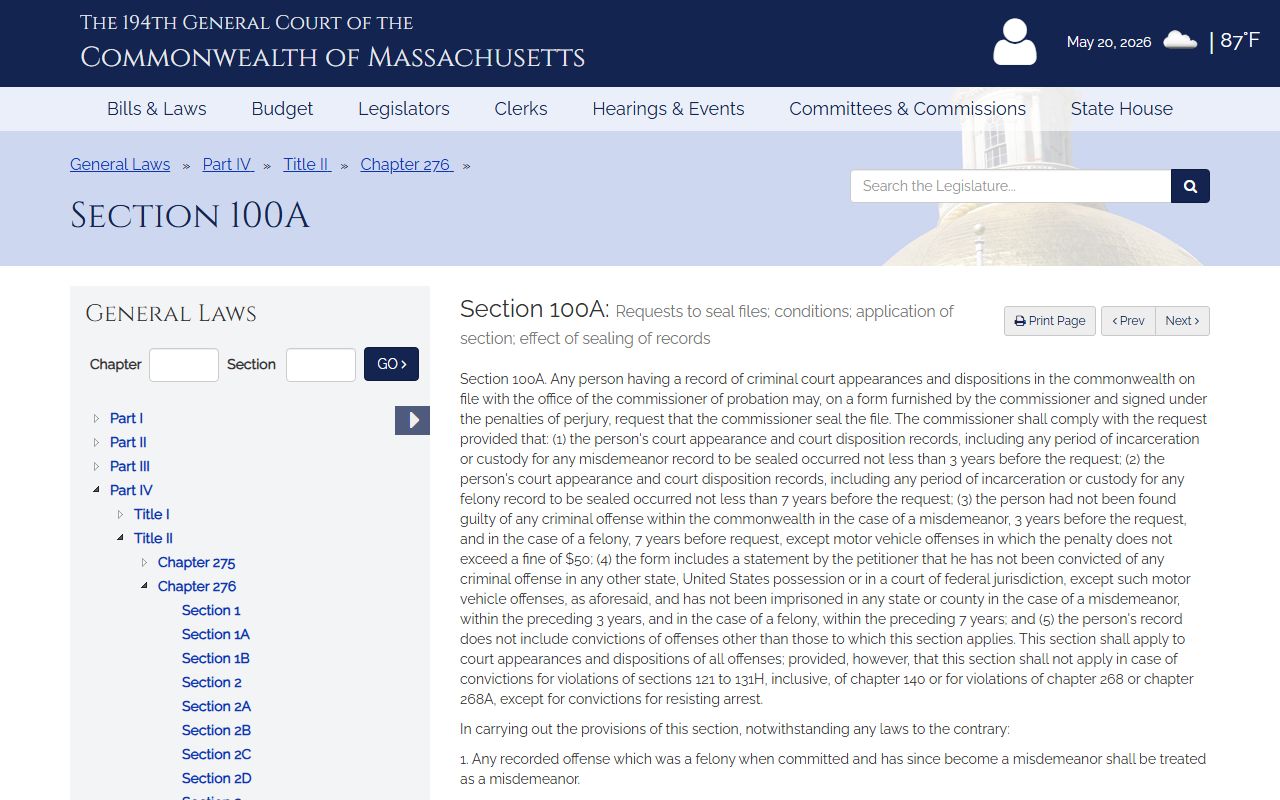
Section 100A covers conviction records. Waiting periods run from the end of incarceration or supervised release, not from the charge date.
The second screenshot is from M.G.L. c. 276, § 100C, which covers sealing when a case ends in dismissal, a not-guilty verdict, no bill, or no probable cause finding.
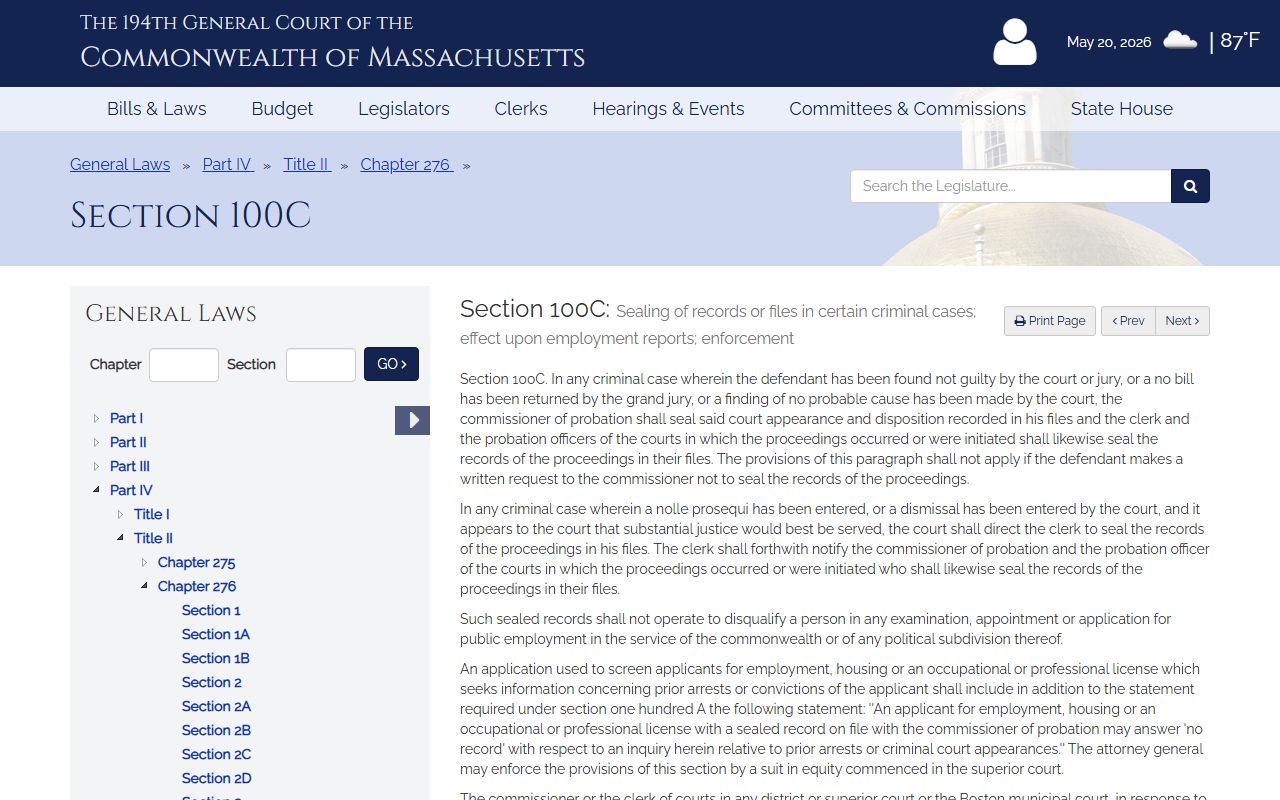
Section 100C matters for Essex County defendants whose charges were dismissed or who received not-guilty findings. Those outcomes remain in CORI until sealed by petition.
| Sealed | Expunged | |
|---|---|---|
| Effect on Record | Hidden from public; record still exists in the system | Record treated as removed under the statute; more complete remedy |
| Law Enforcement Access | Authorized users, courts, probation, some licensors may still see it | Very limited; specific statutory exceptions apply |
| Governing Statute | M.G.L. c. 276, §§ 100A, 100C (primary sealing paths) | M.G.L. c. 276, § 100E |
| Eligibility | Conviction: waiting period required; non-conviction: petition after outcome | Narrow statutory criteria; not available for all offense types |
Common denial reasons include an ineligible offense, an insufficient waiting period, pending charges, wrong court, or a statutory exclusion. After sealing, courts, law enforcement, prosecutors, and probation may still access the record for defined purposes.
Note: Juvenile record sealing follows a separate path under M.G.L. c. 119, § 60A.
Booking and Arraignment in Essex County
After an arrest, the local police department books the person, records identifying information, takes fingerprints, and documents alleged charges. The person may be released on bail before arraignment or held until arraignment if bail is set or denied. Weekend and holiday arrests may involve a bail commissioner. Arraignment happens in District Court for most misdemeanors and initial felony stages. For serious felony charges, the case may move to Superior Court after a grand jury indictment. Once charges are filed, the public docket on MassCourts eAccess shows court events. A person held on bail goes to the Essex County Sheriff's Middleton House of Correction.
Booking-to-court path: Local police booking › bail or hold › District Court arraignment › Superior Court if indicted › trial, plea, or dismissal › sealing/expungement if eligible.
Restricted Criminal Records in Essex County
Several categories of Essex County arrest and criminal records are confidential by statute or court rule. Juvenile delinquency and youthful offender records are generally not accessible through public portals. Massachusetts juvenile statutes limit who can see these files and for what purpose. A standard court or CORI search will not return them.
Sealed records do not appear in public searches once the sealing order takes effect. Expunged records go further and are treated as removed. Records under active police investigation may be withheld under a Public Records Law exemption. Impounded court materials, including certain affidavits and filings in abuse-prevention cases under M.G.L. c. 209A, are restricted by court order even if the case number shows in the public docket.
Arrest and Criminal Record Glossary
The terms below come up often when searching Essex County arrest and criminal records. They are not synonyms, and using the wrong one leads to the wrong place.
- CORI
- Criminal Offender Record Information. Massachusetts's compiled criminal-history system. Access depends on the type of requestor and the offense. Individuals can request their own record.
- Arraignment
- The first formal court appearance after charges are filed. Charges are read, a plea is entered, and bail is set. It is a court event, not an arrest.
- Disposition
- The final outcome of a charge: guilty, not guilty, dismissed, nolle prosequi, or CWOF. A CORI entry with no disposition may still be an open matter.
- Continuance Without a Finding (CWOF)
- A Massachusetts disposition where the defendant admits sufficient facts but no guilty finding is entered. If conditions are met, the case is dismissed. It shows in CORI unless sealed.
- Nolle Prosequi
- The Essex DA's declaration that prosecution will not proceed. The charge is dropped. The arrest may still appear in CORI until sealed.
Essex DA and Indigent Defense
The Essex District Attorney, Paul F. Tucker, prosecutes state criminal cases countywide. The DA's office handles victim and witness services, charging decisions, and diversion programs. Contact details are on the official DA contact page.
The screenshot below is from the U.S. Attorney's Office for the District of Massachusetts, which handles federal criminal matters that may involve Essex County residents. Federal cases are separate from state prosecutions and are tracked through PACER, not MassCourts.
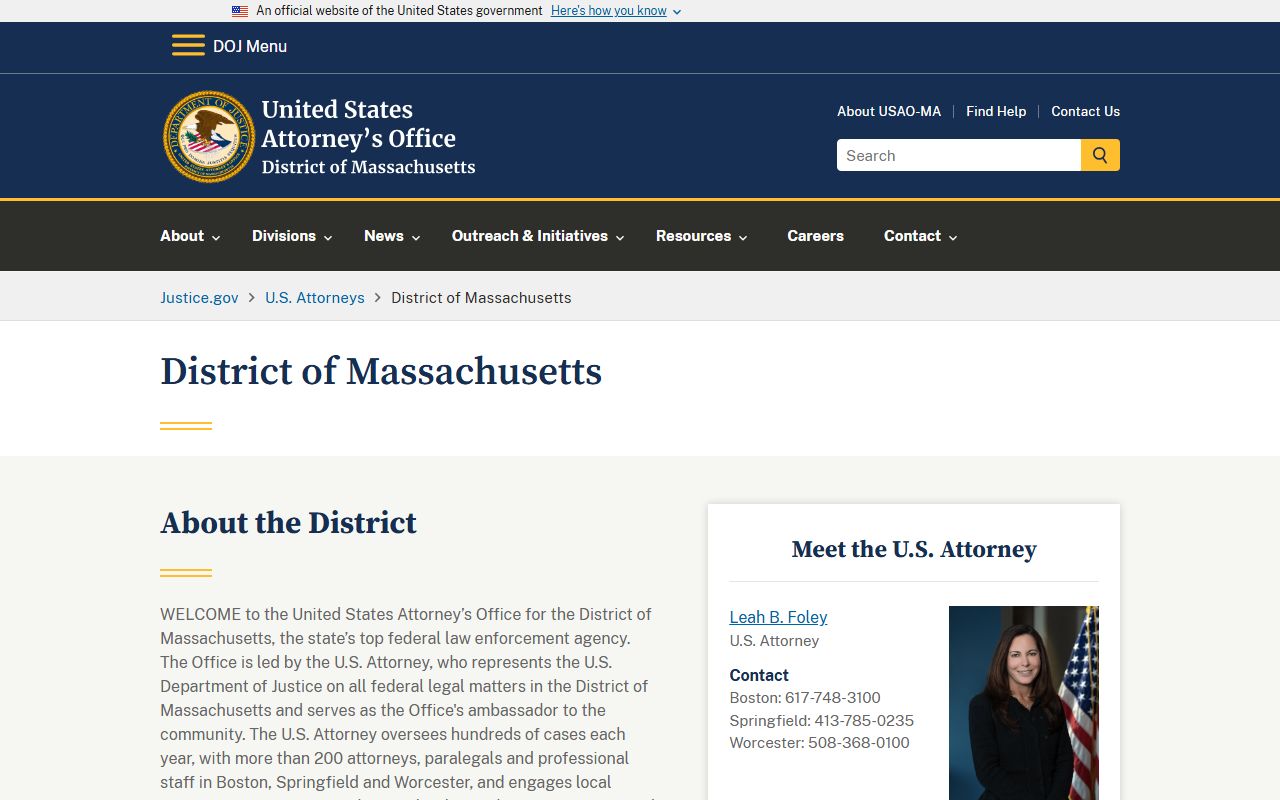
When federal agencies make arrests in Essex County, those cases go to federal court. The public record lives in PACER, not on MassCourts.
For defendants who cannot afford a lawyer, Massachusetts uses the Committee for Public Counsel Services (CPCS). CPCS provides or appoints counsel for eligible indigent defendants in qualifying criminal and related cases. A defendant requests appointed counsel at arraignment. Legal aid resources include MassLegalHelp and the Massachusetts Court Service Centers.
Background Checks and Essex County Arrest Records
A background check covering Essex County criminal history draws from CORI and, for employment or tenant screening, may use a consumer reporting agency. Massachusetts has restrictions on when employers can ask about criminal history and on denying opportunities based solely on arrest records with no conviction. An arrest that did not lead to a conviction still shows in CORI unless sealed. A landlord or employer who sees an arrest entry with no disposition listed may not know the charges were dropped. Confirming the disposition and seeking sealing if eligible are the practical steps available.
Important: This site is not a consumer reporting agency under the FCRA. Information here is not for employment, tenant, credit, insurance, or other regulated screening purposes.