
Massachusetts Public Records: Two Separate Systems
Massachusetts splits public access into two distinct paths. Understanding which path applies to a record is the first and most important step.
The first path is the Public Records Law, M.G.L. c. 66, § 10. This law governs records held by executive branch agencies and municipal offices. In Essex County, that means police department reports, sheriff department logs, city and town clerk filings, and other records kept by non-court government offices. Anyone can ask for those records. The custodian must respond within a set time, provide a fee estimate if costs apply, and give reasons for any denial. Denials may be appealed to the Supervisor of Records. The definition of a public record and the list of exemptions appear at M.G.L. c. 4, § 7, cl. 26.
The second path covers court case records. These are not governed by the Public Records Law. They follow Trial Court Rule XIV and SJC Rule 1:19. Access to a docket, a complaint, or a divorce judgment comes from the clerk or register of the court that holds the case, not through a public-records request. Disputes about court-record access go through the court, not through the Supervisor of Records.
This split matters in practice. If you want a police report, file a public-records request with the department. If you want a court docket or a probate decree, go to the correct court clerk. Sending a c. 66 request to a Trial Court clerk for a case file will not get you far. See the Essex County court records page for the court-record path in detail.
Key Statutes at a Glance
M.G.L. c. 66, § 10 . Public Records Law request procedure: who to ask, response time, fee limits, and appeal rights.
M.G.L. c. 4, § 7, cl. 26 . Definition of public records and list of exemptions that agencies use to withhold or redact material.
Trial Court Rule XIV . Uniform rules on public access to court records, impoundment, and restricted information.
SJC Rule 1:19 . Controls what court records are available online versus only at a courthouse in person.
The screenshot below is from the official statute page for M.G.L. c. 66, § 10 at the Massachusetts Legislature website, which is the central text for public-records requests directed at government agencies in Essex County.
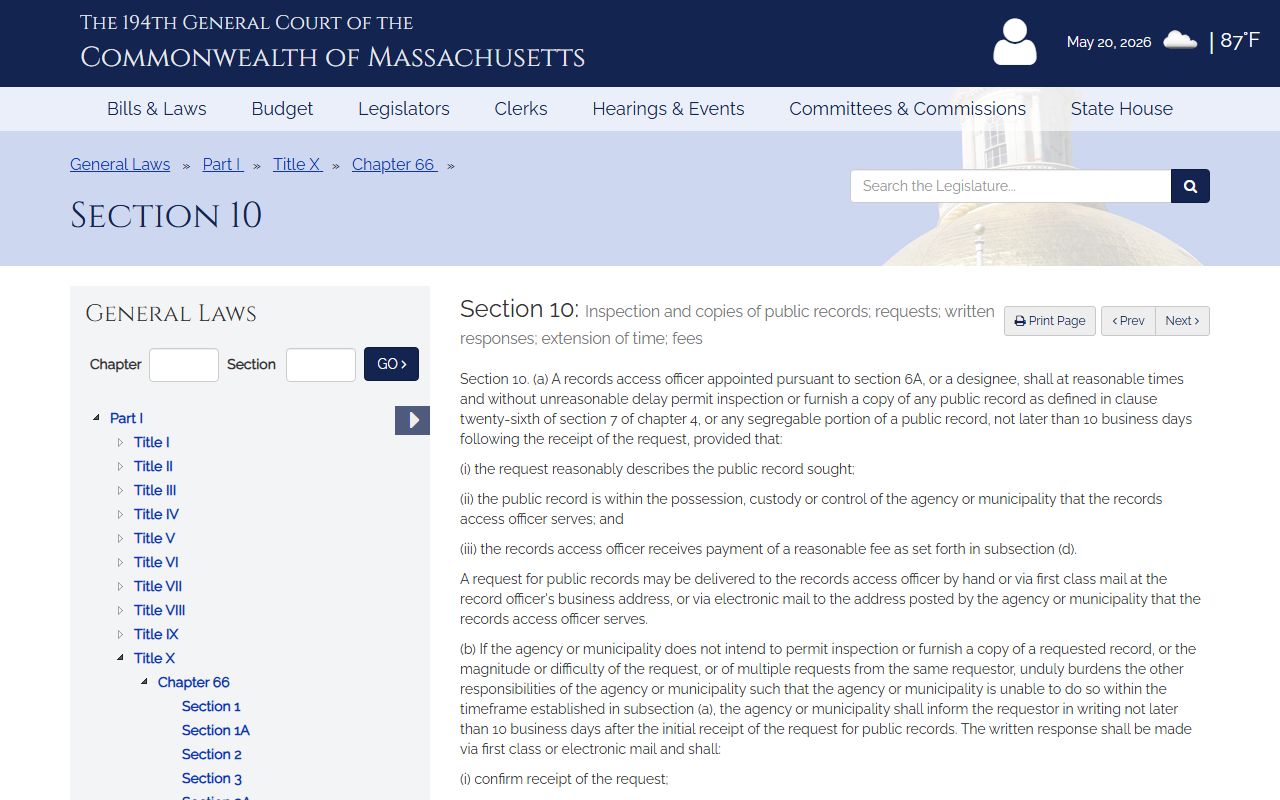
That statute page is also the reference you would cite in a written request if an agency questions your right to the record.
What Essex County Offices Hold Public Records
Essex County does not have a single county clerk that controls all public records. The record you want determines which office you visit or contact. Four main categories cover most requests.
Court case records are held by each Trial Court department at its specific Essex location. The Essex Superior Court clerk in Salem handles Superior Court matters. Eight District Court clerk-magistrate offices serve different parts of the county. The Probate and Family Court Register's office in Salem or Lawrence holds divorce, custody, probate, and guardianship files. The Northeast Housing Court clerk handles eviction and landlord-tenant cases. Each clerk or register is the custodian for that department's records, and each has its own request process. The clerk of court page covers each office in detail.
Land records are held outside the court system entirely. Essex County uses two separate registries of deeds. The Southern Essex District Registry of Deeds in Salem covers the southern part of the county. The Northern Essex District Registry of Deeds in Lawrence covers the north. Both registries are searchable through the statewide MassLandRecords portal. Deeds, mortgages, discharges, homestead declarations, and registered land plans are all kept there, not at a court.
Vital records are split between local and state offices. Marriage licenses and intentions are filed with city and town clerks in the city or town where the license was issued. Certified copies of birth, marriage, and death certificates can be ordered locally or through the Massachusetts Registry of Vital Records and Statistics. The state guide at mass.gov walks through the ordering steps. Divorce, though related to marriage, is a court case in Probate and Family Court, not a vital record kept by a town clerk. The marriage and divorce records page covers both tracks.
Agency and law enforcement records round out the fourth category. Police reports from Salem PD, Lawrence PD, Lynn PD, or any other Essex city or town police department are requested from that department under the Public Records Law. Similarly, records held by the Essex County Sheriff's Department, county health offices, or municipal agencies follow the c. 66 request process described below.
Searching Essex County Land Records Online
The MassLandRecords portal is the free statewide tool for deed and land-record searches. It covers both Essex registries and lets you search by name, document number, or property address without visiting a registry office in person.
The portal's search fields give you several ways to find a record. Knowing the registry, the book and page, or the document number produces the fastest results. Name searches work well for finding all recordings tied to a person or company, but spelling must be exact or close enough to match the index entry.
| Field | Required | Notes |
|---|---|---|
| Registry | Yes | Choose Essex North (Lawrence) or Essex South (Salem) depending on the property location. |
| Search Type | Yes | Options include recorded-land name search, document search, property search, and plan search. |
| Name | Conditional | Grantor or grantee last name; spelling variants affect results. |
| Book / Page | Conditional | Recorded land book and page number; fastest if you have it. |
| Document Number | Conditional | Registered or recorded document number where applicable. |
| Date Range | Optional | Recording date range narrows a broad name search. |
| Town | Optional | Municipality in Essex County; useful for property-based searches. |
| Street / Address | Optional | Address search is less precise than book/page or party name. |
The screenshot below is from the MassLandRecords search portal, the statewide interface that covers the Southern Essex and Northern Essex registries of deeds.
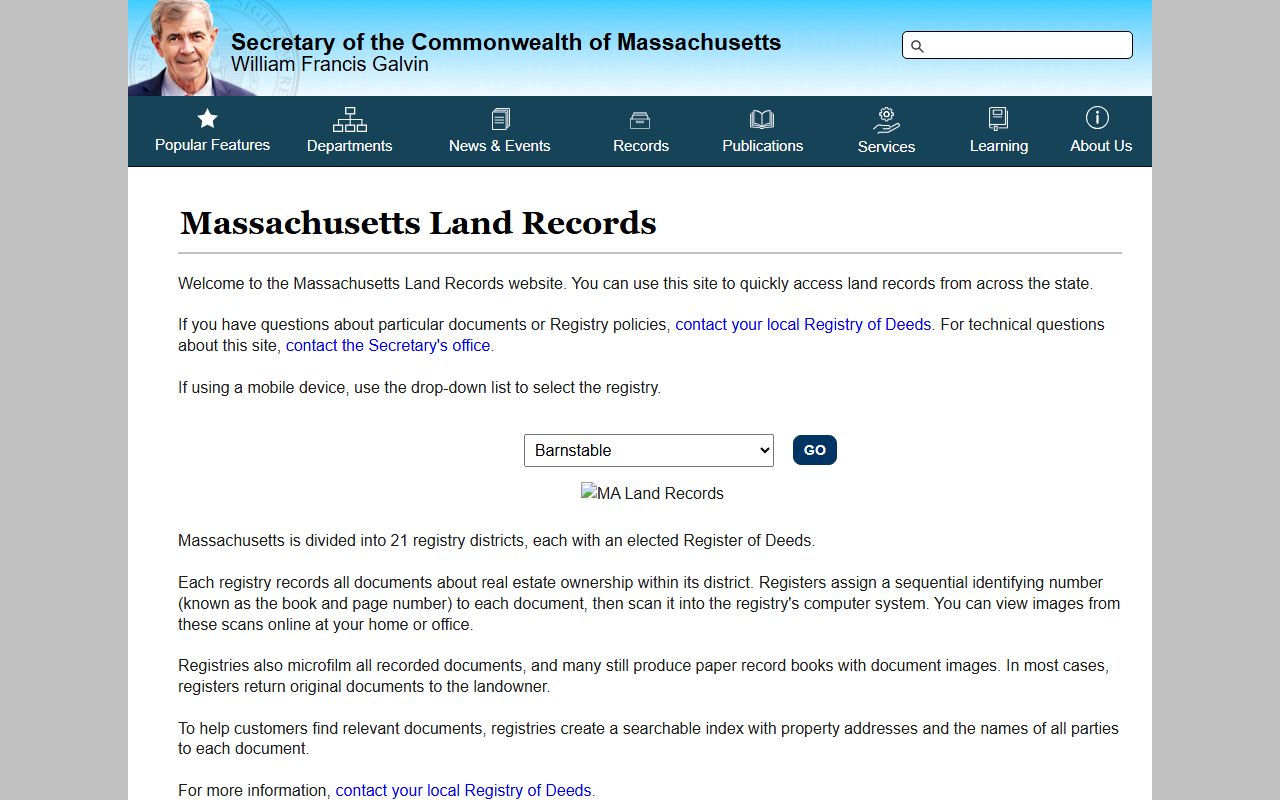
After you pull up a deed or mortgage document, you can view and print it from the portal, though certified copies for legal use require an in-person or mail request to the registry office.
How to File an Essex County Public Records Request
A public-records request under M.G.L. c. 66, § 10 works the same way whether you are asking the Essex County Sheriff's Department, a local police department, a city clerk, or another municipal or state agency. The key steps are the same for all agency records.
- Identify the right custodian. Find the agency or office that created or currently holds the record. A police report goes to the police department. An arrest log goes to the arresting department or, in some cases, to the sheriff. A municipal permit or license goes to the relevant city or town office. Court case files are not covered by this process and go to the court clerk instead.
- Write a clear description of the records you want. Be specific about the subject, dates, and type of document. You do not need a legal reason to ask. However, the more specific your request, the faster the custodian can locate the material and give you a useful fee estimate.
- Submit the request in writing. Massachusetts law allows requests by email, mail, or in person. Many agencies have an online portal or a designated public-records officer who receives requests. Send the request directly to that person or office; sending to a general inbox can delay the clock.
- Wait for the custodian's response. Under the Public Records Law, a business-day response deadline applies. The custodian must either produce the records, provide a written reason for any denial or partial withholding, or give a fee estimate if costs will exceed a set threshold. The exact day limits are set in the statute and were updated by the 2016 amendments to the Public Records Law.
- Review the fee estimate and decide how to proceed. Fees under the Public Records Law follow a schedule tied to copying, electronic delivery, and staff search time. Agencies cannot charge for most electronic records. If the fee seems excessive or the basis for a denial looks wrong, you may ask the custodian to reconsider.
- Pay any lawful fees and receive the records. Once you agree to the fee estimate, the custodian must provide the records within the applicable window. Keep records of your request, the response, and any fee payment in case you need them for an appeal.
Note: Requesting court case records, deeds, or vital record certificates follows different steps at different offices and is not a c. 66 public-records request.
What to Include in Your Request
Massachusetts law does not require a specific form. A clear written statement is enough. Still, including the right information up front reduces back-and-forth and helps the custodian locate records faster. The table below shows what a well-drafted request contains.
| Field | Required | Notes |
|---|---|---|
| Requester Name | Yes | Your name as the person making the request. Identity is not required for most public records, but it helps with mailing and follow-up. |
| Contact Information | Yes | Mailing address, email, or phone so the agency can reach you with a fee estimate or clarifying question. |
| Description of Records | Yes | As specific as possible: subject, event, incident number or case reference if known, date range, and record type (report, log, audio, video, permit, etc.). |
| Date Range | No, but helpful | A specific date or date range narrows the search and can lower costs. |
| Format Preference | No | Electronic delivery (email or download) is often free; paper copies may carry a per-page charge. |
| Statute Reference | No | Citing M.G.L. c. 66, § 10 in the request signals that you are aware of the law and the response deadline. |
| Fee Limit | No | Some requesters state a maximum fee they are willing to pay; this prompts the custodian to estimate before beginning a large search. |
If you are asking for records that may touch on personal privacy, law enforcement investigations, or other sensitive categories, expect that the custodian may produce a redacted version or deny certain portions under the exemptions listed in M.G.L. c. 4, § 7.
Public Records Fees in Essex County
Fees under the Public Records Law are regulated, not set agency by agency. The 2016 reforms placed real limits on what custodians can charge. For most electronic records, fees are not allowed at all. For paper copies and staff search time above a set threshold, the law sets a cap structure. Because the specific amounts are set in statute and may be updated by regulation, the numbers below describe the framework rather than hard dollar figures that could become outdated.
| Item | Amount / Basis |
|---|---|
| Electronic records (email or download) | No charge in most cases under the Public Records Law fee structure. |
| Paper copy per page | Per Public Records Law fee schedule; small municipalities may charge slightly differently than larger agencies. |
| Staff search and segregation time | Allowed above a statutory free-time threshold; rate is capped and must be disclosed in the fee estimate. |
| Registry of Deeds copies | Per the registry fee schedule; request the current schedule from the Southern or Northern Essex registry. |
| Court-record copies | Per the current Trial Court fee schedule; confirmed with the specific clerk or register holding the file. |
| Vital record certificate | Per state and local fee schedules; confirm with the city/town clerk or the Registry of Vital Records. |
Fee waivers are available in some situations. An agency may waive fees for requesters who show financial hardship, for journalists acting in the public interest, or under other criteria recognized by the Public Records Law. Ask the custodian about waiver eligibility at the time you submit your request.
Exempt Records Under Essex County Public Access Law
Not every government record is open. The definition section at M.G.L. c. 4, § 7, cl. 26 lists the categories that agencies can withhold or redact. These exemptions do not eliminate a record; they allow the custodian to keep portions private while releasing the rest. Agencies must identify which exemption applies when they withhold material.
Common exempt categories relevant to Essex County requests include personal privacy (home addresses, medical information, financial details), law enforcement investigatory materials (ongoing investigations, informant identities), personnel records and evaluations, trade secrets and proprietary business information, and records that are protected by other statutes such as juvenile records, adoption files, and health privacy rules. Grand jury materials are secret as a matter of law. Court records that have been impounded by judicial order are restricted by that order and are not reached by a public-records request at all.
- Personal privacy records: addresses, medical info, financial details of private individuals
- Investigatory materials: records that could obstruct a pending investigation or reveal sources
- Personnel files: internal evaluations, discipline, and employment records
- Attorney-client and deliberative-process materials: legal advice and pre-decision internal communications
- Statutorily protected records: juvenile files, adoption records, mental health proceedings, abuse-prevention affidavits
- Grand jury and sealed criminal records: restricted by court rules or statute
A partial denial is common. An agency might release a police report but redact a victim's home address or a juvenile's name. The released portion is still a public record; only the redacted part is withheld. If you receive a heavily redacted response, the denial notice should cite the specific exemption for each redaction.
If Your Essex County Public Records Request Is Denied
A denial or an unsatisfactory response under the Public Records Law can be appealed. The appeal goes to the Supervisor of Records in the Secretary of State's office, not to a court in the first instance. The Supervisor reviews whether the denial was legally valid under the exemptions in c. 4, § 7, and can order the custodian to produce records. The process is designed to be accessible without a lawyer, though you can have one.
If the Supervisor of Records rules in your favor and the agency still refuses to comply, the next step is a civil action in Superior Court. Fee-shifting rules under the Public Records Law can require an agency that wrongfully withheld records to pay the requester's legal fees, which is a meaningful incentive for agencies to respond properly the first time. For criminal records or other records held by courts, the dispute process runs through the court itself rather than through the Supervisor of Records.
Denial appeals follow these steps.
- Review the written denial from the agency to identify which exemptions were cited.
- File a written appeal with the Supervisor of Records. Include a copy of your original request, the agency's response, and any denial letter.
- The Supervisor contacts the agency for its position and reviews both sides.
- The Supervisor issues a determination. If the denial was improper, the agency is ordered to release the records.
- If the agency still refuses after an adverse determination, file a civil action in Essex Superior Court or the relevant Superior Court.