
Marriage Licenses in Essex County
There is no Essex County marriage license office. Massachusetts marriage law, found at M.G.L. c. 207, puts the process with city and town clerks, not with any county agency. A couple living in or marrying in Salem files their intention at Salem City Hall. A couple in Lawrence goes to the Lawrence city clerk. The same rule applies in Lynn, Haverhill, Gloucester, Newburyport, Peabody, Beverly, and every other city and town in the county. Each clerk sets its own fee, its own appointment policy, and its own counter hours, so checking with the specific local office before you go saves time.
The screenshot below links to the Massachusetts marriage statute at the official General Laws site. It is the controlling law for marriage intentions, license requirements, officiants, and impediments throughout Essex County.
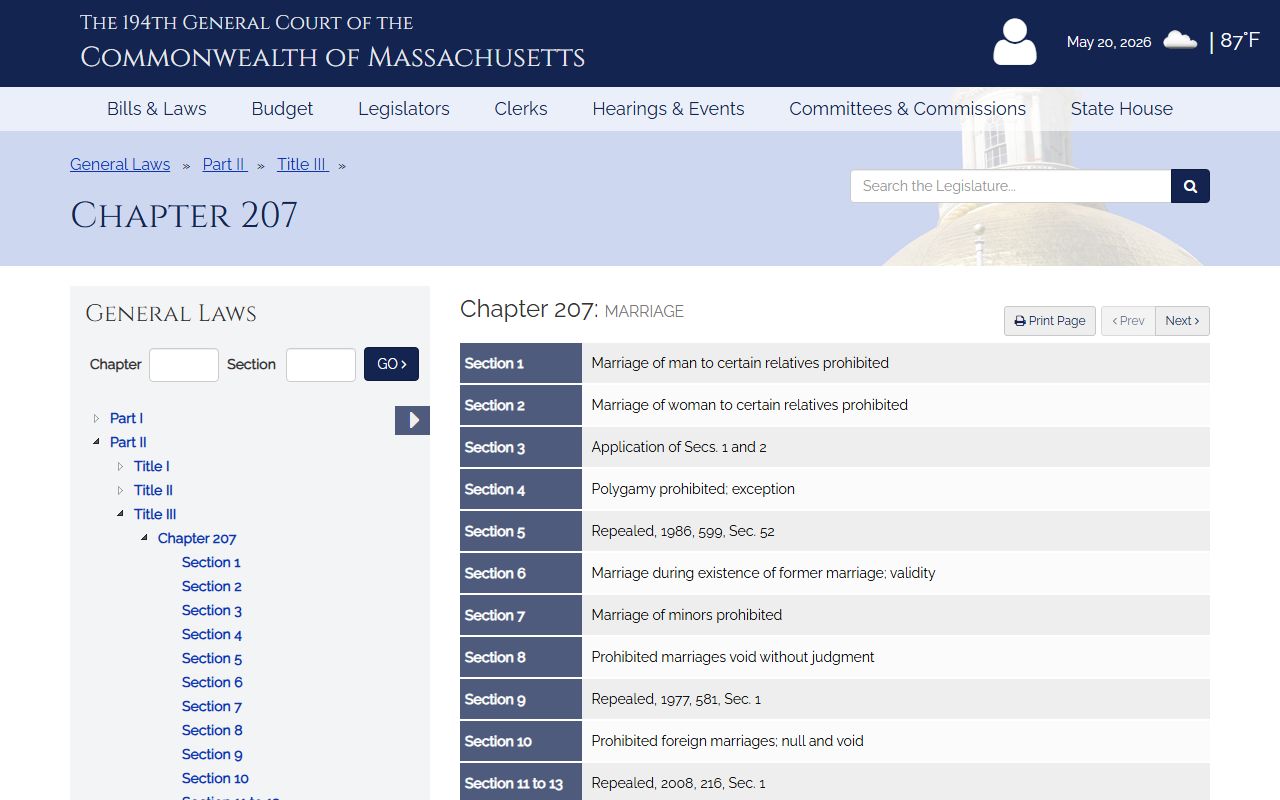
Chapter 207 sets the rules that every Essex city and town clerk follows when they accept a marriage intention, issue the license, and send the certificate back for registration after the ceremony.
Both parties usually need to appear together when filing intentions, though local clerks may have specific policies. Bring government-issued photo ID, know your prior-marriage status, and have parent names ready since the intention form asks for that information. If either party was previously married, have the divorce date or death date available. A Massachusetts waiting period applies between filing the intention and the date the ceremony can be held, unless a judge grants a waiver.
How to Apply for a Marriage License
The steps below follow the standard Massachusetts municipal process. Individual clerks may add steps, require appointments, or accept online pre-filing, so confirm the current procedure with the specific city or town clerk you plan to use.
- Pick a clerk's office. Choose the city or town in Essex County where you want to file the intention. It does not have to be your residence city, but verify with the clerk that the license is valid for your intended ceremony location.
- Gather documents. Both parties need valid photo ID. Have Social Security numbers, parents' full names including birth or maiden names, and the date and location of any prior marriage or its end available before you go.
- Appear together. Both applicants typically appear in person at the same time, complete the intention form, and sign it under oath. Some offices allow one party to sign first and the second to come later; ask in advance.
- Pay the local fee. Marriage license fees are set by each municipality. Ask the clerk for the current amount. The fee is paid at the counter at the time of filing.
- Observe the waiting period. Massachusetts law requires a waiting period between filing intentions and the ceremony date. If you need to marry sooner, the couple may petition a Probate and Family Court judge for a waiver.
- Give the license to your officiant. Once the waiting period has passed, the license is valid. The officiant uses it at the ceremony, signs it with the witnesses, and returns the completed certificate to the issuing clerk for registration.
After the officiant returns the signed certificate, the clerk registers the marriage. At that point you can request certified copies from the same office or, for state-level certificates, from the Massachusetts Registry of Vital Records and Statistics.
Marriage Intention Form Fields
The table below shows the typical fields on a Massachusetts municipal marriage intention form. The exact layout varies by city and town, but the information required is generally consistent because it flows from state law. Verify the exact form with the clerk where you file.
| Field | Required | Notes |
|---|---|---|
| Party A and Party B full legal name | Yes | Names as they will appear on the marriage certificate. |
| Date of birth / age | Yes | Proof of age and identity, such as a driver's license or passport, is typically required. |
| Current residence address | Yes | Street address for each party at time of filing. |
| Place of birth | Yes | City, state, and country. |
| Parents' names | Yes | Full names, including birth or maiden names, for each party's parents. |
| Prior marriage status | Yes | Single, divorced, or widowed. If divorced, the date the prior marriage ended may be required. |
| Intended ceremony date and location | Conditional | Required on some local forms; optional on others. Confirm with the clerk. |
| Officiant information | Conditional | May be left blank at filing if officiant is not yet confirmed. |
| Signatures under oath | Yes | Both parties sign the intention form. Providing false information is a violation. |
| Fee payment | Yes | Paid at the counter. Amount set by each municipality. |
Note: Social Security number is collected on some Massachusetts intention forms and may be required for statistical reporting purposes. Ask the clerk what information is required before your appointment.
How to Find Essex County Marriage Records
Certified marriage certificates are held by the city or town clerk that registered the marriage. If the marriage happened in Salem, the Salem city clerk has the record. If it happened in Haverhill, go to the Haverhill clerk. That local clerk can issue a certified copy on request, and fees are set locally.
For marriages recorded anywhere in Massachusetts, the state-level option is the Massachusetts Registry of Vital Records and Statistics. The Registry holds statewide vital records and allows people to order certified birth, marriage, and death certificates through an online or mail process. The official ordering guide is at mass.gov/how-to/order-a-birth-marriage-or-death-certificate. You will need the names of both parties, the approximate date of the marriage, and the city or town where it was registered.
The image below links to the state's certificate ordering page, which is the most direct path to a state-issued certified marriage certificate for any Essex County community.
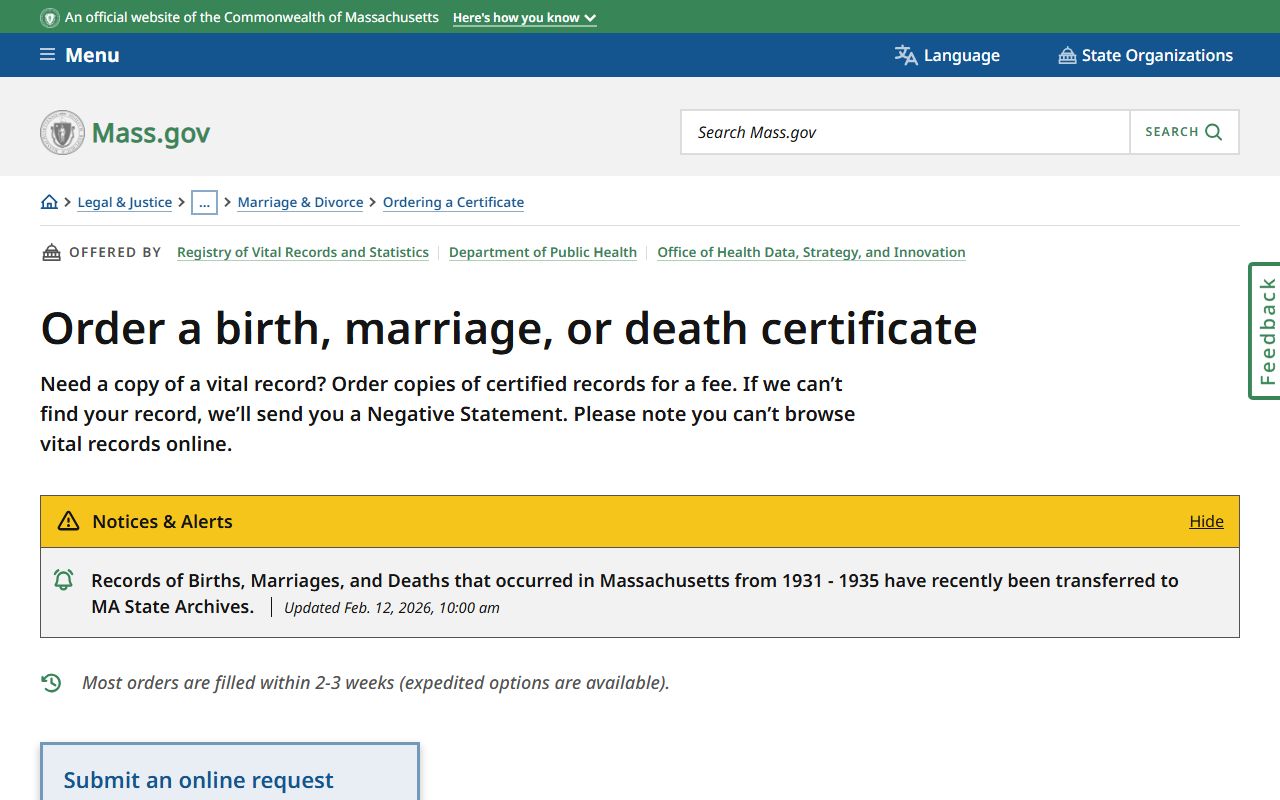
That ordering page covers both local-office and state Registry options, and it explains what ID and payment information the process requires.
Marriage records are not searched through MassCourts or the court docket system. They are vital records, not case filings. If you are looking for a divorce record, that is a separate search through the Probate and Family Court system described below.
Essex County Divorce Records
Divorce is a court matter. Cases are filed in Essex Probate and Family Court, which has sessions in both Salem and Lawrence. The governing statute is M.G.L. c. 208, which covers all aspects of divorce in Massachusetts, from grounds and residency requirements through judgment and modification. An Essex County divorce record is a court case file, not a vital record, so it is kept by the Register's office at Probate and Family Court rather than by a city or town clerk.
The screenshot below links to the Massachusetts divorce statute. It is the same law that governs every case filed in Salem and Lawrence at the Essex Probate and Family Court.
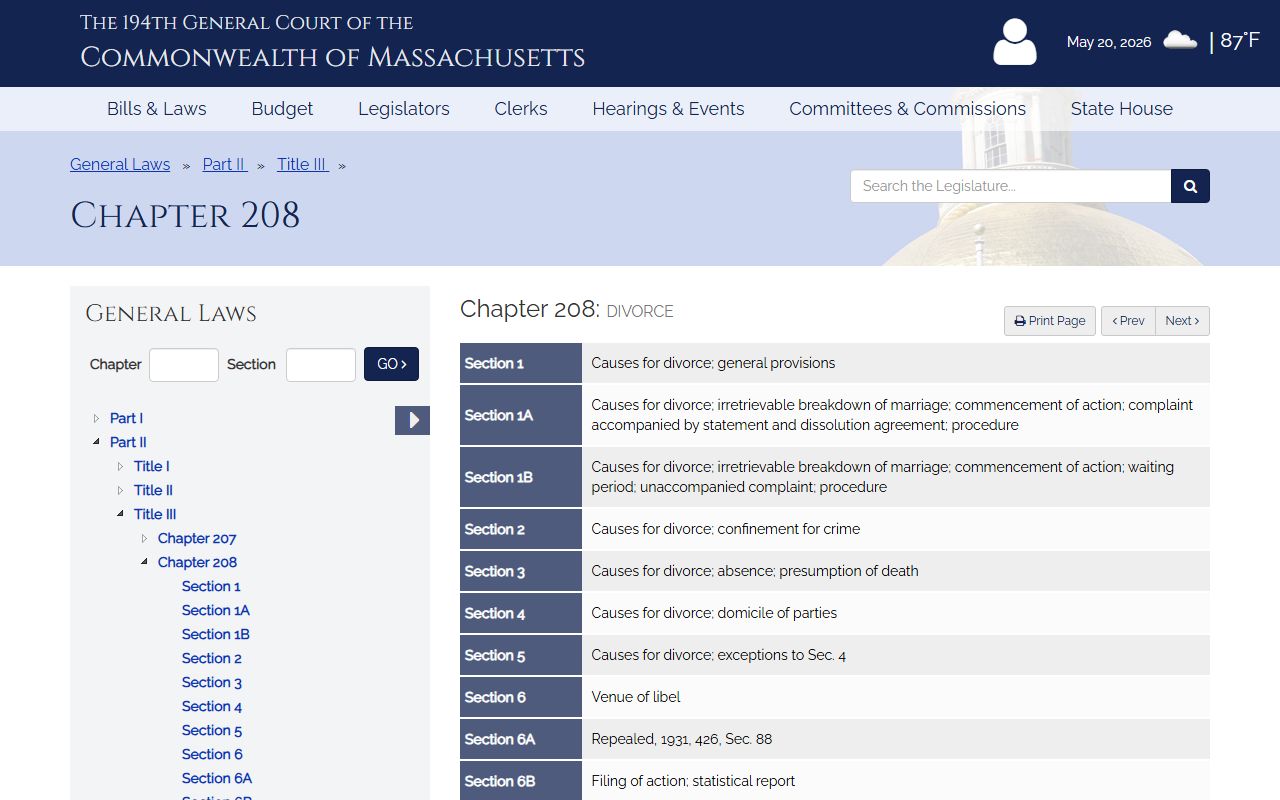
Chapter 208 sets out the no-fault and fault grounds available, the residency requirements for filing in Massachusetts, and the procedure the Probate and Family Court follows from complaint through final judgment.
A divorce file can contain many documents. The public docket typically includes the complaint or joint petition, docket entry dates, hearing notices, and the judgment. Other materials in the file may be restricted. Financial statements filed under the court's standing orders, worksheets related to child support, parenting plans, guardian-ad-litem reports, abuse-prevention history, protected addresses, and medical information may be impounded or limited to parties and their attorneys. The existence of a public docket entry does not mean every document in the file is available to the public online or in person.
Basic docket information for Essex County divorce cases can be searched through the MassCourts eAccess portal. Choose Probate and Family Court as the department, then select Essex County and the appropriate session. Search by case number if you have it, or by party last name if you do not. For copies of actual documents from the file, contact the Register's office directly at the court that holds the case.
Filing for Divorce in Essex County
Divorce cases in Essex County are filed at Essex Probate and Family Court. Massachusetts allows both no-fault and fault grounds, and the type of case, joint petition versus contested complaint, affects the paperwork and timeline. The steps below reflect the general filing path under M.G.L. c. 208; specific form requirements and schedules can vary, so confirm current forms with the Register's office or with an attorney.
- Determine the case type. A joint petition under c. 208, § 1A is used when both parties agree on all terms before filing. A contested complaint under c. 208, § 1B is used when the parties do not have a full agreement at the start. Fault-based grounds are also available but are less common.
- Confirm residency and jurisdiction. Massachusetts requires that at least one party meets the residency requirement. If the grounds for divorce arose outside the state, both parties must have lived in Massachusetts for a period prior to filing. Verify the current requirement with the court or an attorney.
- Prepare and file the forms. The complaint or joint petition, a summons where required, a Civil Action Cover Sheet, and the current filing fee are submitted to the Register at Essex Probate and Family Court. A fee-waiver affidavit of indigency is available for people who qualify.
- Serve the other party. In a contested case, the plaintiff must serve the defendant with the complaint and summons. Joint petitions do not require separate service. Methods and deadlines for service are set by court rules.
- File required financial and child documents. The court's financial statement form is required in cases involving support, property, or asset division. Child support worksheets, parenting plans, and related forms are required in cases involving minor children.
- Attend court hearings. Depending on the case type, the parties may have temporary-order hearings, pretrial conferences, status hearings, and a final hearing or trial. The court issues orders along the way.
- Receive the judgment. After the final hearing, the court enters a judgment of divorce nisi, which becomes absolute after a waiting period. At that point the parties can order certified copies of the judgment or the certificate of divorce absolute from the Register's office.
Certified Copies of Divorce Documents
Not all divorce documents are the same, and different situations call for different certified copies. A lender closing a refinance, an immigration agency reviewing a visa application, a benefits office verifying eligibility, and a person petitioning to legally change a name after divorce may each require a different document from the divorce file. Knowing which one you need before you ask the Register's office saves trips and fees.
The main documents people request from Essex Probate and Family Court after a divorce are the judgment of divorce nisi, the judgment of divorce absolute (or the certificate of divorce absolute), the separation agreement if one was incorporated into the judgment, and the full docket sheet. The judgment says the court has granted the divorce. The certificate of divorce absolute is issued after the nisi period ends and states that the divorce is final. The separation agreement is the contract between the parties that the court approved. Each has a different purpose and a different legal weight in outside proceedings.
To request certified copies, contact the Register's office at Essex Probate and Family Court at the Salem or Lawrence session that holds the file. Provide the full case number, the names of both parties, and the type of document you need. Fees are set by the current Trial Court fee schedule; the Register's office has the current amounts.
For vital-record proof of divorce status, some processes also accept a certified marriage certificate combined with proof of the divorce judgment. Check with the requesting agency to confirm what they will accept before you pay for copies.
Restricted Essex County Family Records
Several categories of material in Essex County family court files are restricted or impounded. The general rule is that a divorce docket is public, but not every document in the file is open. Court rules and standing orders, including Trial Court Rule XIV and the Probate and Family Court's own standing orders, identify which materials must be withheld or shielded from general access.
Financial statements filed in a divorce or support case are a common restricted item. These forms contain detailed asset, income, debt, and expense data that the court requires for support and property decisions, but the standing order limits who can view them. Child-related materials are similarly protected. A parenting plan, child support worksheet, guardian-ad-litem report, and any records that directly identify a minor may be impounded. Protective-order history, addresses protected under safety concerns, and medical or mental-health records introduced in family proceedings also receive special treatment.
Adoption records fall under a stricter confidentiality framework. M.G.L. c. 210, § 5D governs access to adoption records, which are among the most restricted family files. Accessing an adoption file usually requires a court order or specific statutory authority. The image below links to that statute.
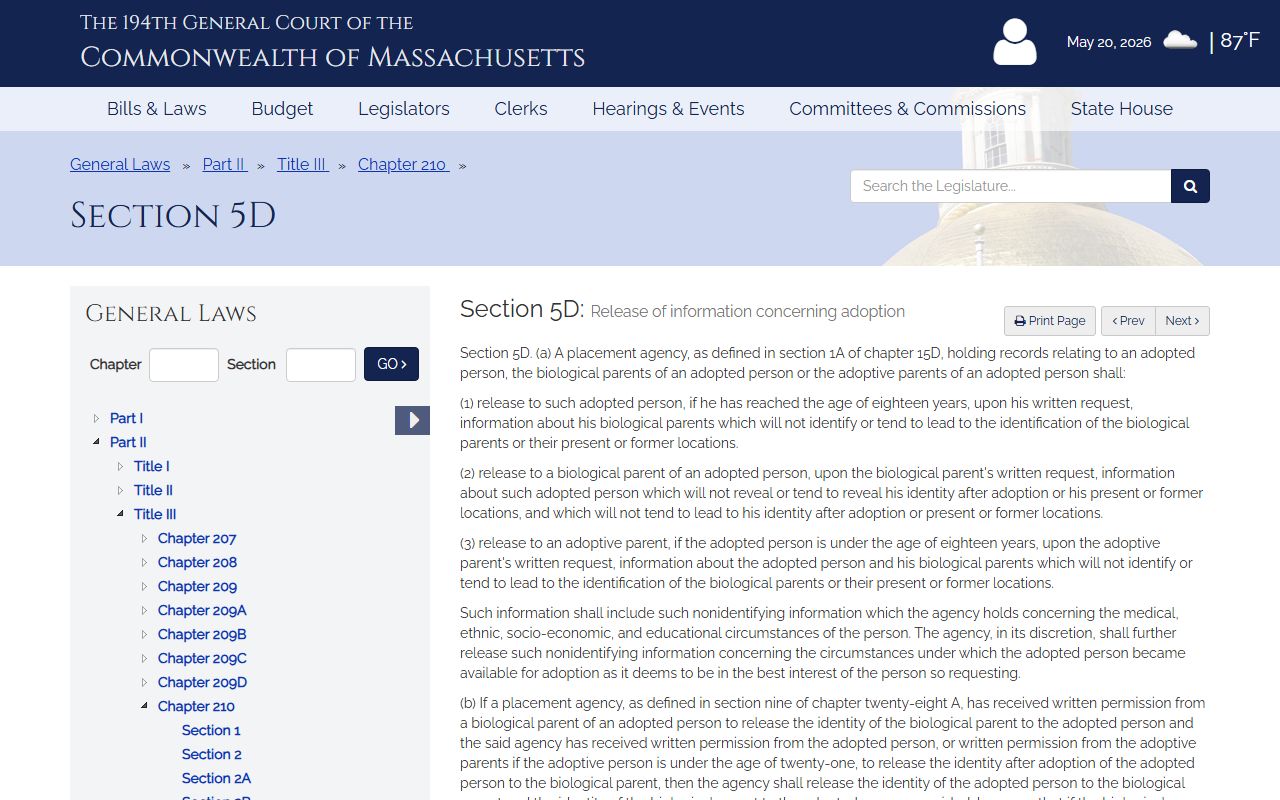
Section 5D limits who may see adoption records and under what conditions, making it very different from ordinary divorce or probate access.
If a document you need is impounded, the usual path is a motion to the court that entered the impoundment order. You state who you are, why you need the document, and the legal basis for access. The judge reviews the request. In some cases, parties to the original action have broader access rights than the general public, so confirm your status with the Register's office before filing a motion.
Essex County Marriage and Divorce Fee Schedule
Marriage license fees are set locally by each city or town. There is no single countywide fee. Divorce filing fees and copy fees are set by the state Trial Court fee schedule, which applies to all Massachusetts courts. Because the schedule can change, the amounts below describe the structure rather than specific dollar figures. Always confirm the current fee with the clerk or Register before you pay.
| Item | Amount |
|---|---|
| Marriage license fee | Set by city or town clerk |
| Certified marriage certificate (local clerk) | Set by city or town clerk |
| Certified marriage certificate (state Registry) | Per current state Registry fee schedule |
| Divorce complaint or joint petition filing fee | Per current Trial Court fee schedule |
| Certified copy of divorce judgment | Per current Trial Court fee schedule |
| Certificate of divorce absolute | Per current Trial Court fee schedule |
| Plain copy per page | Per current Trial Court fee schedule |
| Exemplified copy | Per current Trial Court fee schedule |
| Affidavit of indigency (fee waiver) | No fee if approved |
A fee-waiver affidavit of indigency is available in the Trial Court for people who cannot afford filing or copy fees. Ask the Register's office for the form and the current income threshold. The waiver does not automatically cover all fees in all departments, so confirm what it covers when you submit it.
Massachusetts Vital Records Office
The Massachusetts Registry of Vital Records and Statistics holds the state's centralized vital-record archive and can issue certified birth, marriage, and death certificates for events registered anywhere in the Commonwealth. For an Essex County marriage, the Registry is a useful backup if the local city or town clerk is unavailable or if a requester prefers a single state-issued certificate rather than a locally issued one.
Massachusetts Registry of Vital Records and Statistics
Registry of Vital Records and Statistics
Massachusetts Department of Public Health
mass.gov/orgs/massachusetts-registry-of-vital-records-and-statistics
The Registry accepts requests online, by mail, and in person. For mail and in-person requests, follow the current instructions on the Mass.gov ordering guide. For a marriage certificate, have the names of both parties, the approximate marriage date, and the city or town of registration ready before you begin. Proof of identity or relationship may be required for certain certificate types or for records that are not fully public. Processing times depend on the request method, so check the current estimate on the ordering page.
The Registry does not hold divorce records. Those are court files kept by Essex Probate and Family Court, as described in the sections above. Do not contact the Registry for a divorce judgment or a certificate of divorce absolute.