
How to Search Essex County Court Records
Massachusetts uses one statewide case system, not a separate Essex County database. The main tool is MassCourts eAccess. The state also keeps a plain-language guide on how to search court dockets, calendars, and case information. Both let you look up Essex County court records by party name or by case number. Online access is not complete. Sealed, impounded, juvenile, adoption, and some family and criminal materials may not show up.
Before you start, get a few details together. A case number gives the cleanest result. If you only have a name, know the court department and, if you can, the city where the matter was filed.
Here is the order that works best on the portal.
- Open the MassCourts eAccess portal and pick a search path, such as criminal, civil, or probate and family.
- Choose the court department and the Essex location, like Salem, Lawrence, Lynn, or Newburyport.
- Enter the case number if you have it. This skips name spelling problems.
- If not, search by last name and narrow by first name, court department, and filing year.
- Open the case detail to read docket entries, parties, hearing dates, and status.
- For copies the portal does not show, contact the clerk or register at the court that holds the case.
The screenshot below shows the MassCourts public entry page, captured from the official eAccess portal.
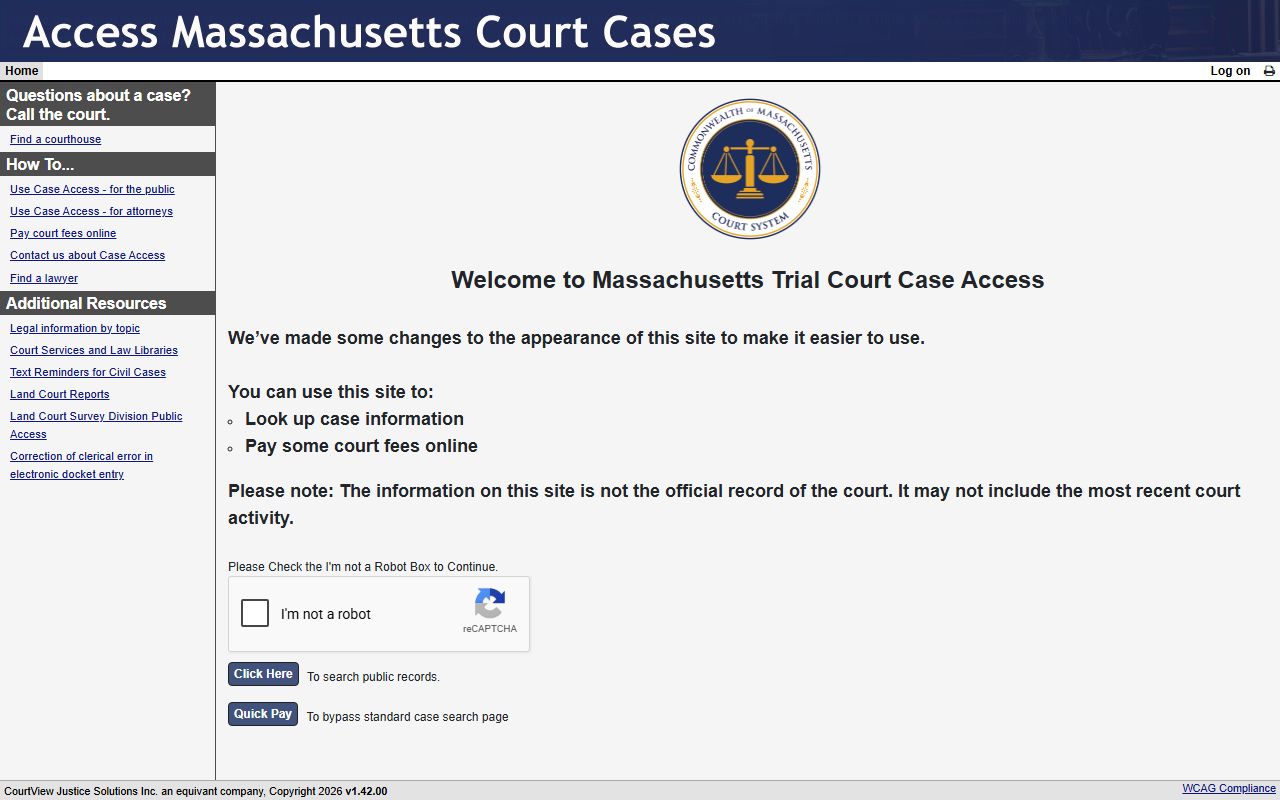
That page is where most Essex County court record searches begin, even for cases filed in the smaller District Court sessions.
The Essex County Judicial System
Essex County court work sits inside the statewide Massachusetts Trial Court. The Trial Court has seven departments. Five of them handle most Essex County matters: Superior Court, District Court, Probate and Family Court, Housing Court, and Juvenile Court. Above the Trial Court sit two appeals courts. The Massachusetts Appeals Court hears most appeals. The Supreme Judicial Court is the highest court in the Commonwealth and the final word on state law.
The Superior Court handles serious felonies, large civil cases, and jury trials. The District Court takes misdemeanors, many first-step felony matters, small claims, and motor-vehicle cases. You can read the full court system overview on Mass.gov.
Case flow: District Court › Superior Court › Massachusetts Appeals Court › Supreme Judicial Court
| Court | Jurisdiction | Case Types |
|---|---|---|
| Essex Superior Court | County-wide, serious matters | Felonies, major civil suits, equity, jury trials |
| District Court | Regional, local matters | Misdemeanors, small claims, civil, motor vehicle |
| Probate and Family Court | County-wide family and estates | Divorce, custody, support, probate, guardianship |
| Northeast Housing Court | Housing disputes | Evictions, code, landlord-tenant |
| Juvenile Court | Youth and child welfare | Delinquency, care and protection, CRA |
Court roles drawn from the official Massachusetts court system pages.
Essex County Courthouses
Essex County court buildings are spread out by design. The county mixes dense cities, old mill towns, and coastal communities, so the Trial Court keeps sessions close to where people live. Superior Court anchors in Salem, with sessions in Lawrence and Newburyport. District Courts sit in eight cities. Probate and Family Court uses Salem and Lawrence.
Lawrence District Court
North-western Essex County
Lawrence, MA
Essex Probate and Family Court
Salem and Lawrence sessions
Salem, MA
The Salem Superior Court is the right place to start for broad county court context. For a divorce or estate, though, the Probate and Family Court is the correct office. More on each location appears on the Essex County District Court page.
Types of Court Records Available in Essex County
Essex County court records cover several kinds of cases. Each kind comes from a different department, and access rules differ. Most are open to the public, but privacy law trims what you can see.
These are the main record types and where they live.
- Criminal records - complaints, arraignments, dispositions, and sentences from District and Superior Court.
- Civil records - contract and injury suits, small claims, and money judgments.
- Family and divorce records - divorce, custody, and support from Probate and Family Court.
- Probate records - wills, estates, guardianship, and conservatorship files.
- Traffic records - motor-vehicle complaints and citations handled in District Court.
Land records and marriage records are not court records, but people search them in the same breath. Deeds sit at the registry of deeds. Marriage records start with city and town clerks. See the public records page for more on that split.
What Essex County Court Records Show
A court record is mostly a docket plus the filings behind it. The docket is the running list of what happened in the case. The public view in Massachusetts is often docket-centered, so you may see the events even when you cannot download the documents. Here is the field set you can expect when you open an Essex County case.
| Field | What It Shows |
|---|---|
| Case Number | The department-specific docket number; format varies by court and year. |
| Court and Location | The department and Essex session, such as Salem or Lawrence. |
| Parties | Plaintiff and defendant, or petitioner and respondent; sensitive names may be hidden. |
| Filing Date | When the complaint, petition, or indictment was filed. |
| Disposition | The outcome, such as dismissed, default, judgment, or guilty. |
| Docket Entries | Each motion, hearing, order, and notice in date order. |
Social Security numbers, bank numbers, minor names, and protected addresses are redacted by rule. The court records page breaks each field down in more detail.
Public Access Laws for Essex County Court Records
Massachusetts splits public access into two systems. The Public Records Law covers agencies like police, the sheriff, and city clerks. Court case files follow their own court rules instead. So a police report request goes one way, while a docket or divorce judgment comes from the court clerk. Privacy statutes, CORI rules, and impoundment orders limit both.
Key Statutes:
M.G.L. c. 66, § 10 - sets how to ask an agency for public records, the response time, and how to appeal a denial.
Trial Court Rule XIV - the uniform rule on which court records are public and which are restricted.
SJC Rule 1:19 - controls what can be viewed online versus only at the courthouse.
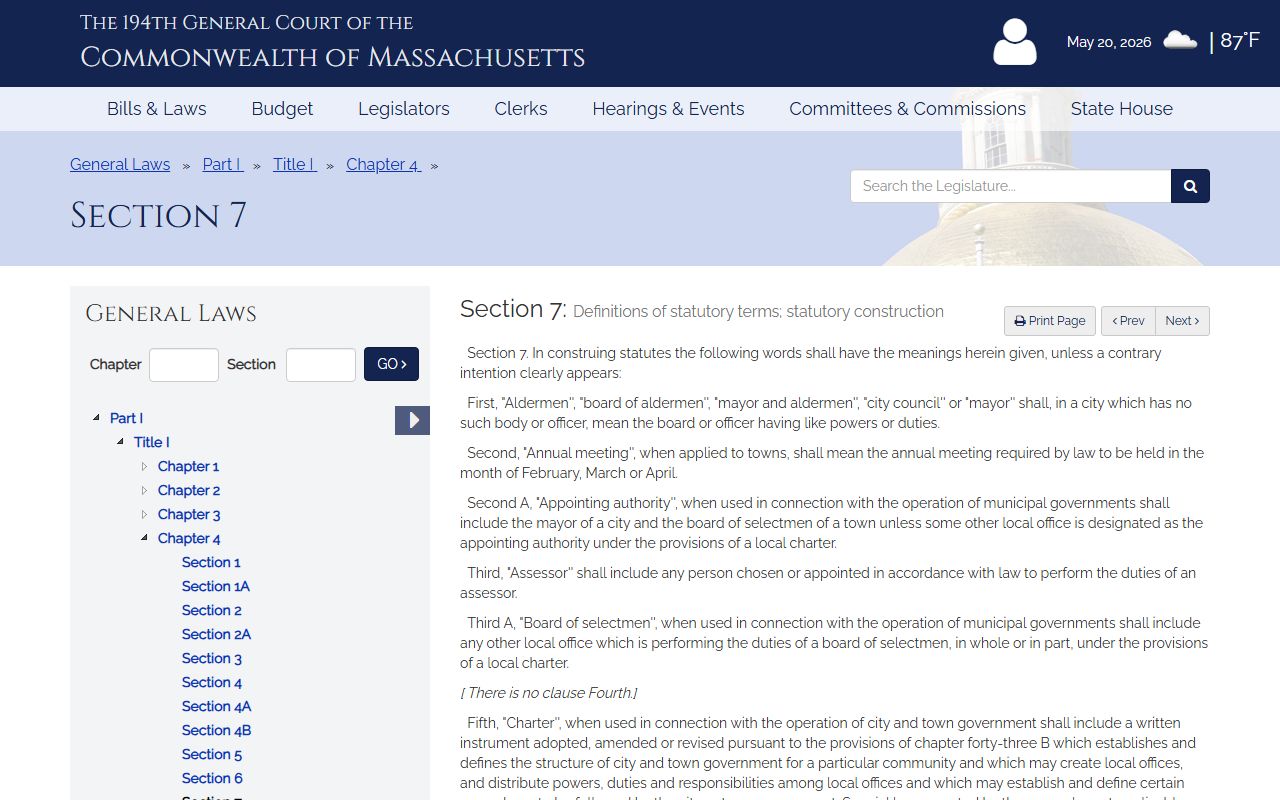
The image below comes from the official statute page for the definition of public records at M.G.L. c. 4, § 7. It lists the exemptions that let an office redact a record. Reading it helps explain why some Essex County records come back blacked out.
Records That Are Restricted or Confidential
Not every Essex County court record is open. Some are sealed, some are impounded, and some are confidential by statute. These are not the same thing. Sealed records still exist and stay open to police, courts, and probation. Impounded records are restricted by a judge's order, sometimes only one document. Expunged records are removed under a narrower law.
Juvenile cases, adoption files, mental-health commitments, and abuse-prevention affidavits sit behind the strongest limits. To view a sealed record, the person usually petitions the court that handled the case and shows a legal basis. The arrest records page covers sealing and expungement in more depth.
Specialty Courts in Essex County
Massachusetts runs problem-solving sessions through its Trial Court departments. Essex County defendants may have access to a Drug Court or Recovery Court session. These use judicial supervision, treatment, testing, and frequent review hearings. The public docket may list the court dates, but treatment details stay private.
Veterans Treatment Court is a second track. It serves eligible defendants with military service and treatment needs, often working with VA services, mentors, and probation. Eligibility is not automatic. To learn whether a session serves a case, ask the District Court or Superior Court clerk or the probation office. Mental-health diversion and competency sessions round out the specialty options.
Essex County Sheriff and Jail
The Essex County Sheriff's Department runs county custody, reentry, transport, and programs. Sheriff Kevin F. Coppinger leads the department. The main facility is the Middleton House of Correction, with added programming at the Lawrence Correctional Alternative Center. The official sheriff site is the controlling source for visiting, mail, and money rules.
Essex County does not post a live public jail roster in the official sources reviewed. For custody status, use sheriff channels, the state inmate guide, or VINE. See the Essex County inmate records page for the full roster and search details, and the warrant records page for active warrant and default questions.
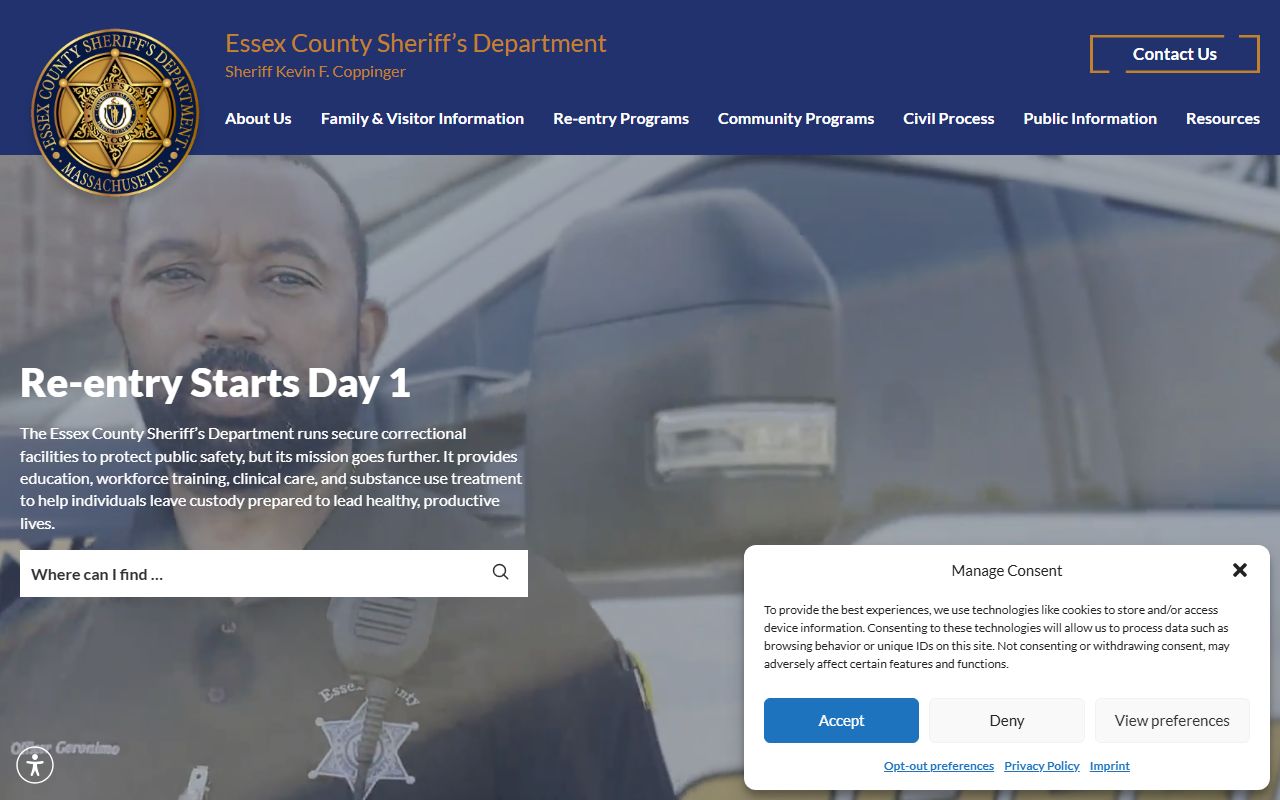
The screenshot below is the Essex Sheriff homepage, the starting point for facility and visiting information.
Marriage, Divorce, and Probate Records
Family records split across offices. Marriage starts with a city or town clerk. Divorce is a court case in Probate and Family Court. Estates and guardianship are also probate records in that same court. A few common terms help when you read these files.
- Testator
- A person who makes a will.
- Executor
- The person named in a will to settle the estate; in Massachusetts often called the personal representative.
- Conservator
- A person the court appoints to manage the money of someone who cannot.
Divorce judgments, certified marriage records, and probate decrees each come from a different custodian, so ask the correct office for a certified copy.
Essex County Court Records Fees
Court copy fees in Massachusetts are set by the current Trial Court fee schedule, not by the county. Amounts can differ by department and document type. Because the official schedule changes, confirm the current fee with the clerk or register that holds the record before you pay.
| Item | Amount |
|---|---|
| Plain copy per page | Per current Trial Court fee schedule |
| Certified copy | Per current Trial Court fee schedule |
| Certification fee | Per current Trial Court fee schedule |
| Exemplified copy | Per current Trial Court fee schedule |
Note: A fee-waiver affidavit of indigency may cover some court costs for people who qualify.
How to Interpret Essex County Court Records
Docket language is short and can be confusing. A few labels carry most of the meaning. "Commonwealth v." means a criminal case. "Plaintiff v. Defendant" is usually civil, housing, or small claims. "Petitioner v. Respondent" shows up in family and petition cases. "Estate of" points to probate.
Watch the status words too. "Continued" means rescheduled, not dropped. "Disposed" means the case has an outcome, but you must read the entries for the detail. "Default" can mean a missed date and, in criminal or motor-vehicle cases, may carry a warrant. A charge is not a conviction. The docket disposition tells you which one applies.
Accuracy and Record Limitations
Online court data is a tool, not a certified record. Update timing varies by department, clerk workload, and event type. A new filing or a recalled warrant may not appear at once. A missing online result does not always mean no case exists, since older, sealed, or transferred matters may not show.
Note: Always confirm a date, charge, or disposition with the clerk or register that holds the case before you rely on an online Essex County court record.
History of Essex County Courts
Essex County is one of the historic counties of Massachusetts, and Salem has long been a legal center. The county's court story runs from colonial-era courts, through the Salem witch trials, the mill-city growth of Lawrence and Lynn, and on to the modern statewide Trial Court. The spread of sessions in Salem, Lawrence, and Newburyport reflects that long, regional history rather than a single county courthouse.
Frequently Asked Questions
How do I search Essex County court records online?
Use MassCourts eAccess and the Mass.gov docket search guide. Pick the court department first, such as Superior, District, or Probate and Family. Then search by case number if you have it, or by party name if you do not. Remember that sealed, juvenile, and impounded records may not appear.
Is there one Essex County clerk of court?
No. Massachusetts does not use a single county clerk for all records. Each Trial Court department and location has its own clerk, clerk-magistrate, or register. Land records sit at the registry of deeds, and marriage records start with city and town clerks. See the clerk of court page for the full breakdown.
Where are Essex County divorce records kept?
Divorce records are held by Essex Probate and Family Court in Salem or Lawrence. You can look up the docket on MassCourts and ask the Register's office for a certified copy of the judgment. The marriage and divorce records page has the steps.
More answers are on the Essex County court records FAQ page.